Due to their home and the possibility to go out into the alleyway leading past their house and interact with the passers-by, Puzzle and her siblings already got a good deal of default human socialization. Our neighborhood has lots of kids who tend to play soccer and ride their bikes or simply run around in the alleyway (there are no cars, which makes it a safe place to play and hang out). Kids, of course, love puppies, so the puppies got lots of kid time from the time they were old/brave enough to follow their mom out into the alley. In addition, the family that had the litter has a kid themselves – around 7 years old – so the puppies had contact with a child even before they left the nest.
Crowded spaces
The socialization experiences I added on top of this were more urban: I took Puzzle to the most touristy places of Guanajuato, to the busiest open-air taco stands, and walked her around cars and other traffic and city noises – a level of business and noise that is absent in our neighborhood. You’ve already seen Puzzle around people in this leash walking post. Here’s another example from a different plaza I used to take Puzzle to:
Plaza Baratillo
A car-free plaza I used to take Puzzle for off-leash exploration and people-watching.
La Universidad de Guanajuato
People-and-traffic-watching from the stairs of Guanajuato’s university.
These are just some examples of the crowded-place excursions Puzzle and I took.
Inside places
We also entered little supermarkets, bakeries and pharmacies together to help Puzzle adjust to different inside spaces. You can see two example pictures in this post.
Open urban spaces
Apart from crowded outdoors areas and small businesses, we also went to large, open urban spaces: another type of environment that is missing in our pedestrian, narrow-allied neighborhood, but may be part of her future life, no matter whether she ends up with a free-roaming life or a pet life.
This first video is outside of the litter’s home range, but a fairly quiet place. While there isn’t a lot going on, this place is wide and open, which makes it very different from Puzzle’s alley and most environments of our town. To get there, we have to walk along a traffickey street, which also adds a new experience. Seeing and getting used to people in different contexts and environments is important!
Cerro del cuarto
La Alhóndiga
Meeting a free-roamer at the Alhóndiga.
Watching the world go by at the Alhóndiga.
The video below shows some loose leash walking practice at a busier part of the same plaza the pictures above were taken. You’ll see me handling the leash on my middle finger in this video. This, too, works – experiment, and find out which finger loop works best for you and your puppy!
The video below shows more leash walking around the Alhóndiga, around running kids. Included here for your amusement is me yelling at a guy who wants to touch Game. Game, you see, has been instructed to stay with my cellphone on its tripod and make sure no one steals it while I am videoing and focusing on Puzzle. Yes, I’m not being friendly to that guy. In my defense, I doubt he wants to find out what happens if a (generally very friendly and social) Malinois in working mode believes you are about to take my tripod. He heeded my advice, and Game held her stay. Good girl!
My next post is going to be a bit of a mixture of stuff – cute, funny, or useful clips/pictures that didn’t quite fit under any of the headings of the Puzzle series. Stay tuned! 2 more Puzzle posts to come … unless I think of something else! I feel like Sheherazade. I keep writing and writing, putting off the last post in the Puzzle series, and defying George Harrison.
Yes, FINALLY, this is the one with the cute puppy videos!
I promised you a gameshowesque extravaganza. Well, here you go. If I had all the time in the world (and more patience with technology), I would do this Hannah Whitton style. Alas, I am neither particularly patient with technology nor do I have the time. So for now, I give you amateur-style fun with a – drumroll! – puppy video analysis game!
Puzzle’s confidence around dogs has been growing steadily. The videos you’re about to see are not chronological though because I downloaded and edited them at different times, and don’t remember what happened when. I tried going from least confident to most confident in this post.
Video 1:
We don’t see this dude a ton, but we do see him now and then. He and Game know each other; Puzzle has never seen him.
What do you see? Social facilitation? Social learning? All, none, or some of the above? Go, and share your answers in the comments of the blog post!
Video 2:
Meeting Toby (He carries his tail strangely because he can’t raise it. Maybe he broke it at some point.) Toby lives in this street, and Game and I see him a lot. How do you code the interaction(s) of Toby, Game and Puzzle? Go!
Video 3:
Game greets a disinterested and somewhat stiff bully-breed mix. He’s only a rare visitor around here – it’s more Game’s home turf than it is his. Puzzle watches from a safe distance.
Watch the video, and decide: is this social learning? Is it social facilitation? Is it imitation? Is it none of the above, all of the above, or something else entirely? Let’s see your analysis, and your reasons for it, in the comments!
Video 4:
The Mal mix is a friend of mine and Game’s. He’s a resident of the area, and Game and I meet him a lot. How do you code the interactions in this video?
The cute and the messy! Because life. And because the trainer and human I strive to be is authentic rather than giving you a polished version of our sessions.
The handler as a safe space
Video 5:
The video below shows Game and Puzzle; an adolescent Husky (Game knows him), and a little female mix (another one of Game’s acquaintances). This is approximately the third time that Puzzle has seen the two dogs. You’ll see me using proximity to my body as a safe space for Puzzle, and how this helps her handle the situation. Due to the video angle, you can’t see this, but I’m making sure the two dogs can’t touch or sniff Puzzle. She feels safe sitting and observing next to me (around 00:30).
Free-roamers tend not to be pushy around people, which makes it easy to keep the Husky and the little female out of Puzzle’s personal space. A little over a minute in, the two dogs have lost interest, and I’m getting up to give Puzzle more agency again.
Also, yes, the flowy red scarf you see me wearing is poop bags. I’ve always had a knack for fashion. Thank you for noticing!
About two minutes in: how cute can a puppy possibly be? doG, isn’t she the funniest, bounciest, silliest little thing?
02:10 Here, Game notices the zooming puppy and wants to chase her. This is too much for Puzzle: while she trusts Game, there’s still a big difference in size, speed, and general Malinoisness. Game can be overwhelming. When this happens, I interrupt, and keep Game out of Puzzle’s personal space. Puzzle knows this – at 02:15, you’ll see her ask for my support. I’ll calm them both down, and send Game on her way to find someone her own size to malinois with.
Puzzle is no worse for wear: as soon as Game takes off running at 02:30, she chases after her! Chasing is fun! Being chased … not yet. Gotta grow up a little more first! If Puzzle stayed with me, this should cease to be a problem in a few weeks, once Puzzle was a little older, faster, and bigger.
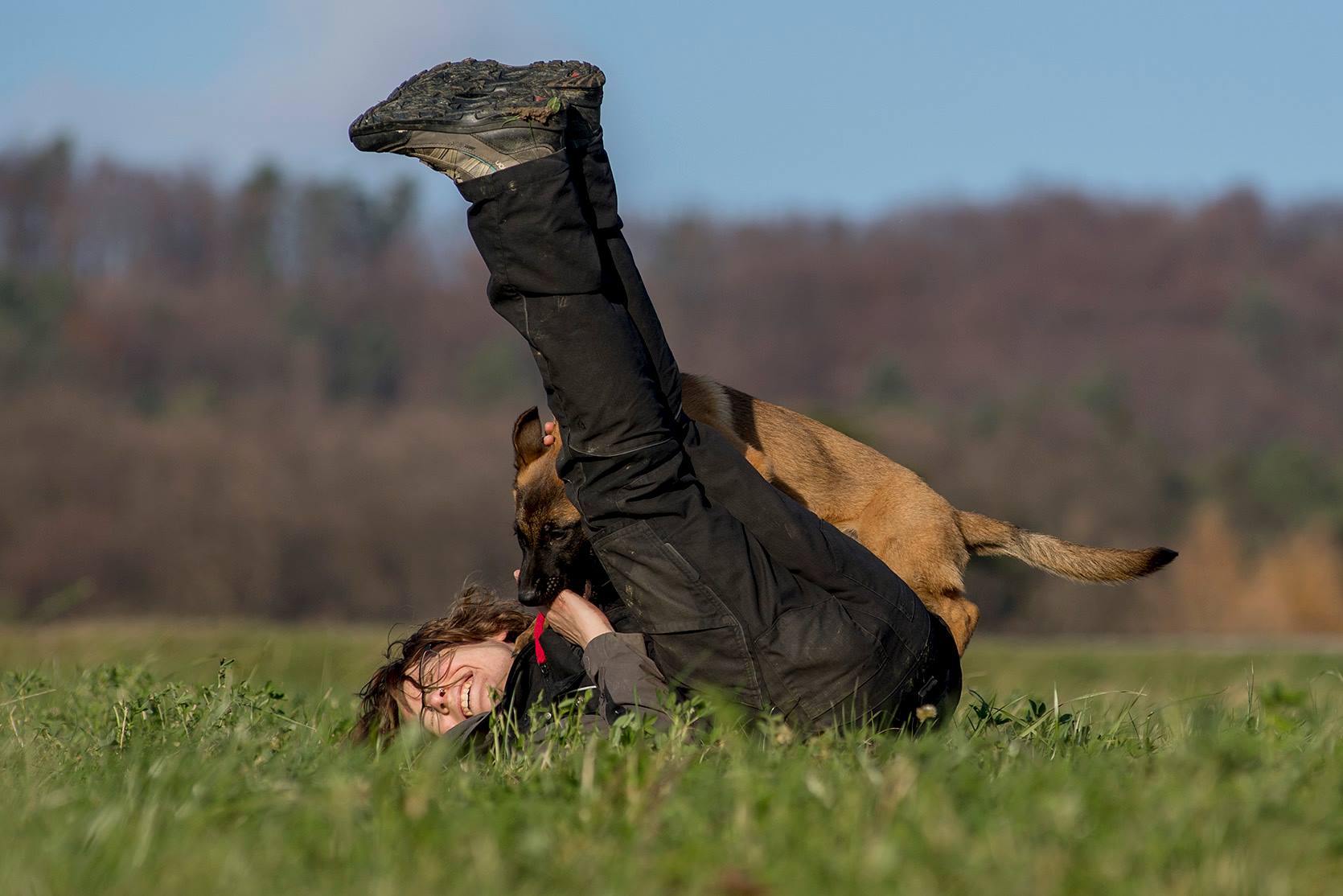
Around 02:55, I can’t resist Puzzle’s playfulness, and just have to join the fun! Puppies are easy to play with. Just watch what they do naturally, and follow their lead! In this case, we’re running around together. (Social play would be the technical term for playing without food or toys; in FDSA land, the term we use is personal play.)
03:01 Game, of course, wants to join the fun! She LOVES social play. Around 3:28, I start bringing down Game’s energy a little. I like roughhousing with her, but this is not the right context. Look at how Puzzle is trying to join the fun by jumping up on Game!
04:02 Game’s arousal is still higher than I’d like it to be in this situation (as evidenced by her barking). Letting her come into middle position and massaging her ears helps turn things down a notch. As for Puzzle? Well, let her bounce and jump all over us. Game doesn’t have to be jealous – right now, all my attention is on her. So we both let Puzzle be her happy, bouncy, silly self. She’s the least bitey puppy I’ve ever had, by the way. She has never hurt me when trying to play. Which is fascinating. I guess that’s the puppy raising experience of non-working-dog folks? Something about it feels almost wrong.
Alright – take a stab at analyzing the video below! What do you see in terms of social learning, imitation, facilitation etc? Go!
Risks, rewards, and ways of life
Video 6:
Below is a long video filled with interesting interactions: bouncy play with another puppy (starts out with Puzzle being a bit too forward!), interaction with an adult male (the other pup’s dad?), and Puzzle feeling overwhelmed when Game would like to chase her. Long, but worth watching – there’s a lot going on in this clip! The second puppy is a little younger than Puzzle, which is why they are less well coordinated. I don’t interrupt because the other pup’s dad (he might also be the mom’s alloparenting housemate rather than the sire) is handling the situation much better than I, a human, ever could.
I’m not advising you to try this with your own puppy. If I was sure Puzzle was going to a pet home in a different part of the world, I might avoid these kinds of interactions altogether. Since pets won’t have these interactions as adults, there is no reason to store them in the “safe and satisfying” folder in their growing puppy brain right now. Depending on how risk-averse or -tolerant you, the human, are, the risks (however small) might outweigh the rewards.
As a free-roamer, Puzzle will absolutely have these kinds of interactions, and she will need to be able to manage them well. If she were to grow up to be my own dog (a take-everywhere dog), living in this part of the world, she’d need these skills as well. She has a dog and a human looking out for her here. For her, the rewards of these experiences outweigh the risks by far. This is the puppy I am raising: one that can deal with dogs of all sizes and dispositions in a free-roaming world. At the same time, I’m making sure the synapses she’d benefit from as a pet dog won’t get pruned, either: being confined, walking on a leash, being inside buildings, housebreaking, traffic, city life. We’ll take a look at some of those in my next post.
Video 7:
Below is another long clip, interesting to watch in terms of body language. Puzzle tries to play with the little adult female. She just got woken up by Puzzle, and says, “No!” Puzzle keeps trying to engage her.
I do not intervene here, but would if this were going on longer. It’s not okay to let your puppy harass another dog who doesn’t defend themselves, but is uncomfortable. However, it doesn’t come to that: the little female’s pandilla comes to help her: the Mal mix and the adolescent Husky (both male) either live with her or are her neighbors. The three of them always stick together. They happen to be interested in playing, but Puzzle is intimidated by their size. You’ll see me take a hands-off approach again. (Let me repeat: I do not recommend this unless you are well-versed in canine body language.) Puzzle is clearly not comfortable when the two big ones start chasing her. There’s a few reasons that I let them work it out themselves: I know the two bigger dogs. They try and play nicely; I know that when they realize they are scaring Puzzle, they will slow down. Indeed, at 01:11, the Mal mix lies down (self-handicapping), and at 01:17, the Husky shows a play bow without pushing into Puzzle’s personal space. I also know that Puzzle has learned that I’m a safe space for her. If she comes to hide behind my body or stand/sit between my legs, I will keep all other dogs away. She chooses this option at 01:28. From that moment onwards, I will not allow the other dogs to have direct contact with her. When they continue trying to engage her in play, I’ll pick her up. She has learned this is safe, and will immediately relax in my arms.
Another reason I am pretty relaxed around Puzzle’s interactions with other dogs is that she may grow up to be a free-roamer herself. This means she’ll have to be able to resolve these situations on her own, and she’ll have to learn to respect bigger dogs: in most of her future dog encounters, there will be no human to help her. The rules of engagement (who gets the pop culture reference?) are different for free-roamers than they are for Western-style pets. I want Puzzle to have both sets of rules in her playbook: freely interacting with other dogs, and disinterestedly passing dogs on a leash.
Coming up next: human socialization and urban spaces for Puzzle! I’ve got material for two more content/video-heavy Puzzle posts before I will get philosophical, and share the end of the Puzzle Week series with you. Tiem flies, my friends. Time flies.
You’ve already learned that for the automatic leash pressure method to work, you and your puppy will only walk forward on a loose leash. You’re still missing something crucial though: a way of measuring leash pressure. In order to be successful with the automatic leash pressure method:
You need a way of measuring the amount of pressure your puppy is putting on the leash.
You need to define the amount of pressure that will trigger a stop.
And you need to consistently apply this metric anytime you are walking your puppy on their LLW equipment (e.g. collar).
Can’t you just play it by ear? No, sorry – you can’t. People are notoriously inconsistent when doing this kind of training based on their gut feeling. This is confusing to puppies. They may learn to keep their leash loose anyway … Or they may not. In any case, it will likely take longer. So instead of fumbling our way through, let’s keep our criteria crystal clear from the start!
Measuring leash pressure
Here’s the elements will be looking at:
1. How to hold the leash in order to effectively measure pressure.
2. How to do the actual measuring and define a point of tightness that will trigger stopping.
3. How to define that the leash has loosened again, triggering movement.
How to hold the leash to effectively measure pressure
Find your default finger loop
Make a loop with the thumb and index finger of your dominant hand (left image below). Look at your hand. Feel your hand. What does it feel like for your thumb and index finger to touch?
Get up from your chair and let your arms hang down by your side, standing relaxedly (right image above). Do your fingers still touch each other or is there a gap between them? How large or small is the gap? Do this exercise in front of a mirror! Remember that I want you to consciously relax your arm and your hand. If there is a gap between your thumb and index finger, think about the kind of object that would snuggly fit between them. For me (right image above), this is a piece of kibble: I could put a single piece of kibble between thumb and index finger of my relaxed hand and it wouldn’t drop to the ground. For you, there may be no gap at all, or there may be a slightly wider gap. Maybe your object is a walnut, a pea or a bottle cap! Maybe all that fits is a piece of paper! If you’re not sure, experiment with the objects you find around your kitchen or living room!
Next, start walking, swinging your arms loosely and naturally by your side. Pay attention to the distance between your thumb and index finger. Is it the same distance you had when standing still or does it change with movement? In my case, it’s the same: a single piece of kibble would snuggly fit into the gap between my thumb and index finger. Spend 30 seconds consciously describing the feeling and the default size of your gap: what is the relaxed distance between thumb and index finger when you are standing still or walking? How would you describe it to someone on a voice call who can’t see the gap?
The reason I’m having you pay close attention to your finger loop is that we aren’t usually aware of it and how it feels. We need to change this for the measuring method I’m about to teach you to work.
Now that you have raised your awareness of what it feels like to have your arms swinging loosely by your side, grab a leash. Hook the handle on your index finger while keeping your arm, hands and fingers just as relaxed as before. If your default position is a slightly open loop – no need to close it.
Note that there’s no dog attached to my leash! This part is just about you and the leash.
Now, start walking around the room again. What does the weight of the leash feel like on your index finger? Think about it as if you were describing the sensation to someone over the phone: they can’t see you and they don’t have a leash to try it themselves! Keep your arms and hands relaxed as you walk around the room and focus on the sensation of the fabric wrapped around your finger. The weight. The way it affects your finger loop. Let the leash drag on the floor behind you as you walk.
For the next step, add a collar to the leash and attach the collar to a piece of sturdy furniture about the same height as your puppy’s neck. The handle of your leash goes on your index finger again.
The effect of leash pressure on your finger loop
You’re now going to explore what it feels like when there is pressure on the leash: what will your finger loop do? Start out with your loop in its relaxed default position. Take a few slow steps backwards, watching and sensing what is happening to your index finger. Can you feel how the loop being pulled open when you step back and the leash goes tight? What does it look like now? The opening will be bigger – maybe instead of a piece of kibble, you could snuggly fit a clicker-sized object in the gap when it’s fully opened by the pressure of the leash. What does it feel like when it’s just opening a little because you’ve taken a smaller step back? Maybe the size of two pieces of kibble instead of just one? How does this feel different from the default position of the leash on your finger loop? Try it with both hands. Watch your finger loop expand and pay attention to the changing sensation in the muscles and skin of your fingers. Repeat a few times with the leash on the index finger of both hands!
Going forwards, when you work with your puppy on LLW, this is how you’ll hold the leash: with the handle hooked into your finger loop; your hand and fingers relaxed.
How to do the actual measuring and define a point of tightness that will trigger stopping
You are going to measure the tightness of the leash by means of whether your finger loop is open or closed. Let’s define “closed” as the relaxed position of your loop. For some people, the thumb and index finger will actually be touching each other when the arm is hanging down by your side in a relaxed way. For others – such as me – there will be a small gap.
Now that you know what “closed” means, let’s look at an open(ing) finger loop: anything more than your relaxed default position means that the leash counts as tight. In the case of someone whose relaxed finger loop means touching thumb to index finger, the moment a piece of kibble fits into that loop already constitutes a tight leash. On the other hand, for me, that same amount of opening (kibble-sized) is relaxed. But the moment the imaginary piece of kibble drops to the floor (due to the dog pulling my loop further open), my leash will count as tight.
Once you have defined what tightness means to you, the next step is straightforward: anytime the leash tightens (your finger loop opens past its relaxed position), you will stop. You won’t reel your dog in. You won’t jerk on the leash. You’ll just stop. Every single time, no exceptions.
How to define that the leash has loosened again, triggering movement
As long as you keep the muscles in your arm, hand and fingers relaxed, your finger loop will go back to its relaxed position as soon as the leash loosens. The moment your finger loop returns to its default shape, the leash counts as loose again. You can measure this both visually by looking at your hand, and tactilely by feeling your loop close and, in case your relaxed default is completely closed, by the sensation of the tips of your thumb and index finger touching each other. As soon as this happens, you’ll start walking again.
How operant and classical conditioning work hand in hand
A classical association
Over time, your puppy will learn that there’s a clear stimulus-stimulus relationship:
Leash pressure on neck —> everything stops.
No pressure on neck —> freedom to move.
Operant learning
Once your puppy has realized the classical association, they will learn to manipulate it. Now, we’re firmly in operant territory! Through trial and error, the puppy is going to figure out that they control the pressure on their neck. They will learn what turns the pressure on: charging ahead or moving a certain distance (depending on the length of the leash you are using) away from you. They will realize that these behaviors are like pushing the “everything stops” button.
Everything stops button
They will also learn how to turn off the pressure on their neck. They will realize that there are several “freedom to move” buttons they can push when they feel pressure on their neck.
Freedom to move buttons
Let’s ask Puzzle to show us the most common ones:
+ Sitting down + Weight shift backwards + Turning towards you + Moving towards you
The videos below center on the finger loop and on the four green-button behaviors Puzzle can use to get me moving again after the leash tightened. Note how her movement affects my finger loop! Also note how brief the stops are. The automatic leash pressure method isn’t annoying to teach – you can go on a normal walk and actually cover ground while you practice … as long as you have a puppy who hasn’t learned to pull on a leash yet!
Alright – that was quite a lot of theory and practice sans dogs! Now head outside and give it a try with your puppy! Have fun!
In the first puppy leash skills post, you saw two unedited clips of what the automatic leash pressure method looks like in practice. This post is all about drilling deeper.
One of the laws of automatic leash pressure is that you never get to pull on the leash or reel your puppy in. However, sometimes, you’ll find yourself in a situation where you need a puppy straining at the end of their leash to get out of the way. Maybe there’s a kid with an ice cream cone about to stumble over your puppy, or maybe they got off the sidewalk and are trying to cross a busy road. This brings us to our ancillary skills. These skills have a single purpose: they will allow you to move your puppy without jeopardizing the golden rule of never pulling on the leash and never reeling puppies in.
Ancillary skill #1: follow a treat magnet
Teach your puppy – independent of leash training – to follow a treat you hold in front of their nose for at least a few steps. Take the treat between thumb and index finger, present it in front of the puppy’s nose and steer them in whichever direction you want them to go by having them follow the treat. Here’s an example of applications in real-world LLW contexts.
In the video below, Puzzle wants to eat something on the ground that I don’t want her to eat (looks like eggs someone broke). I use a treat magnet to get her to keep going – and the leash stays loose.
Here, I don’t have a video helper, so I just walk up and down with the camera set up at a distance. Puzzle thinks it’s weird that we are turning around to walk back to the camera. She sits down. I wait a few seconds, but she doesn’t look like she’s planning on getting up anytime soon. Treat magnet (in combination with a little treat toss) for the win! I reactivate her with food and we keep going. (Sorry about the blurry video!)
Ancillary skill #2: be comfortable being picked up!
If things are scary and your puppy wants to take off running rather than continuing their loose leash stroll or you realize you are late for a Zoom meeting and have to get back home ASAP, there’s a simple solution: pick them up and carry them. Puppies who learn that they are always safe when you carry them will even learn to seek you out (rather than bolt) when they get scared. Practice picking up your puppy at home and in other low-stress environments to build positive associations!
Not exactly a LLW context, but I’m using the puppy pick-up skill here at a small convenience store (left picture) and at a pharmacy (right picture): I want to take Puzzle places to get her used to the world, but I don’t want her to walk inside these businesses since she isn’t yet housebroken. Picking her up is the best of both worlds!
As a rule of thumb, I tend to use ancillary skills 1 and 3 if the puppy is merely distracted, and ancillary skill 2 if they are scared or if I am in a hurry. That’s because walking voluntarily gives a dog more agency than being carried – and agency is a good thing!
The best way to carry your puppy is either in a comfy bag or supporting their butt and back legs with your arm/hand.
Ancillary skill #3: call them over!
Sometimes, you don’t have treats, feel like the distraction is too low to warrant the use of treats or your Saint Bernard puppy is getting too heavy to be picked up. Being able to call or otherwise entice them to come to you is perfect for these moments: again, it will allow you to move your puppy without tightening the leash or reeling them in. Just like picking up your puppy, this is something you’ll want to practice in a low-distraction environment, outside of the context of leash walking. For me, it tends to just happen naturally as I interact with a puppy throughout the day: I end up building both an informal recall (In my case, “Pupupup!” as well as a kissy noise), and teach them that me squatting down or doing playful piano fingers on the ground is a cue to approach me. When I need it in the real world of LLW, the behavior will be ready!
Here’s a brief example of using a kissy noise, squatting down and the beginning of piano fingers to get Puzzle out of the way of the stranger and their kid:
I won’t necessarily treat when using ancillary skill #3. Just get the puppy where you need them to be and then keep going!
Now that you’ve got a good idea of ancillary skills, there’s one more crucial element missing: you need a way to measure the pressure your puppy is putting on the leash in order to guarantee consistency. How much pressure will cue you to stop? It should always be the same amount, independent of your state of mind, where you are walking or how lazy or high-energy your puppy is feeling. We’ll look at how to develop a simple measuring system in my next post!
Apart from some fun CU work, I was excited about getting Puzzle’s assistance in videoing the steps for one other skill: loose leash walking!
Those of you who have taken my Out & About class know that I’m an opportunistic LLW teacher: depending on the dog, owner, goals and circumstances, I’ll apply one of several different LLW approaches. The method I’m going to share with you today is one I don’t generally talk about in my classes. Let’s call it the automatic leash pressure method.
I’ve only used this approach in some of my own puppies (and never in an adult dog). I just don’t have enough data to feel like it is something I want to teach to people who are paying me. If you give this a try with your puppy after reading my post, be sure to let me know how it’s working for you!
The force of habit
Our strongest behaviors are habitual ones: they are the ones we do unthinkingly, without involving the decision-making prefrontal cortex at all. Our body is so used to performing them that they are on autopilot. For example, when I’m driving and there’s a red light, my foot will automatically step on the break and slow down. I don’t have to consider my options and think about whether or not I want to stop. I don’t have to turn off the podcast I’m listening to in order to not be too distracted to make said decision. The behavior is on autopilot, no matter whether it’s rushour or I’m the only car on the road, and no matter whether I’m singing along with the radio, talking to the person in the passenger seat, or keeping an eye on my GPS. I’ll even step on the break if I’m driving in Thailand (i.e. on the left side of the road) rather than in one of the right-side-of-the-road countries I’m used to. Habits are habits because we’ve engaged in them lots of times in all kinds of contexts, and we have never not engaged in the habit: running red lights is not on an intermittent reinforcement schedule. I’ve stopped at red lights ever since I learned to drive, every single time.
A classical conditioning approach
This kind of habit is what I want to build in the automatic leash pressure approach. Unlike any of my other LLW methods, which rely on operant conditioning, this one is mainly about classical conditioning.
What do I mean by this? Well, in this context, stimulus A is always and without exception followed by stimulus B, independent of the puppy’s behavior. Stimulus A is the leash tightening. Stimulus B is stopping.
A ——-> B Leash tightens ——-> Movement stops
When A happens, then B happens. No exceptions. Ever. Like gravity. You may not be able to rely on many things in this Covid-ridden, white supermacist world of looming climate catastrophy, but there is one thing that always holds true: when leahes tighten, all movement stops.
A puppy who grows up in a world of tight leashes stopping movement doesn’t question this fact of life: it has always been that way, and always will. The puppy will adjust to this world without question.
The theory
If you consistently stop any time the leash tightens even just a little bit, from the first time the puppy wears a leash onwards, you will end up with a puppy who unthinkingly gives in to leash pressure anytime they feel pressure on their collar for the rest of their life.
Ancillary skills
There are a few ancillary skills that are helpful for you, the human, to train (treat magnet; getting the puppy comfortable being picked up; calling the puppy over).
There’s also a specific way of measuring how much pressure is too much pressure (i.e. when you need to stop) that will help you be consistent.
I’ll share this in a subsequent post!
The videos below are just to give you a brief overview: yes, I stop a lot – but I it doesn’t slow me down significantly; it’s not an annoying way of walking a puppy. Also note that this is a really busy and difficult environment: if Puzzle didn’t constantly forget about leash pressure among all these people, there would be something wrong with her.
You’ll see me stop if she needs time to sniff behind me, move the leash to the other side if she wants to walk there, and use a treat magnet once to redirect her from eating something I don’t want her to eat. In the second video, I squat down and call her over to get her out of the way off some passers-by. This is really important: I will never pull on the leash to get her to move! It is Puzzle who needs to loosen the leash. I’ll help her if she needs help – but never by means of reeling her in.
Also pay attention to the different strategies Puzzle can use to loosen a tight leash. I don’t care what strategy she picks – weight shift back, turning towards me, sitting down … The moment the leash loosens, we’ll start walking again.
Btw, and the place she wants to go into in the second video? It’s a butcher shop. Lots of good smells!
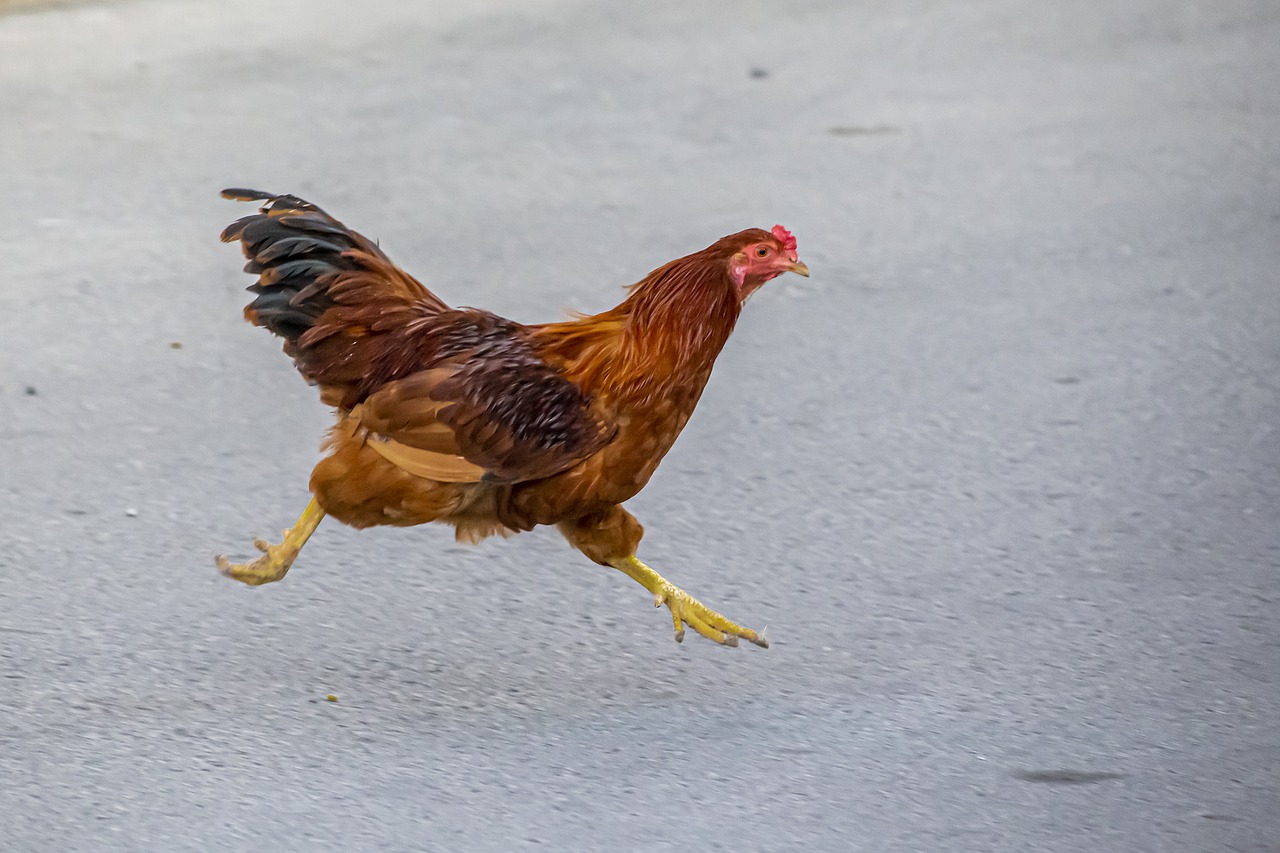
San Marcos La Laguna is teeming with free-roaming chickens. They are in the streets, they are in the yards, they are behind fences and outside of fences. Roosters cockadoodledoo all night, and chickens, big and small, enjoy their life (until they don’t).
Where we used to live for the past 2.5 years, there was one trail that led past chickens and turkeys. My dogs initially craved a bite or two, but soon learned to walk past without giving it much thought. They accepted that killing chickens just wasn’t in the cards for them.
When we got to San Marcos la Laguna – the first stop of our slow travel road trip – Game showed me she had generalized her walking-past-chickens skills. I walked her off leash, and she was great at strolling past chickens without paying attention to them. Until The Day That Changed Everything.
The Day That Changed Everything
Our morning walk to the lake led us past a metal gate with a gap below, just tall enough for a chicklet to squeeze out into the street. One morning, we were walking past the gate as usual, minding our own business, when a little chicklet ducked under the gate, and tried to cross the f*ing road. By the time I noticed the wee bird, it had strolled right under Game’s muzzle. “What’s that?” Smack! Game lowered her Baskerville-muzzled nose, and that chicklet’s road-crossing intentions were cut short. Game was delighted! Who knew that smashing down your muzzle makes the little feather toys stop moving! So much power! So much fun!
(I found the owner, apologized, and paid the equivalent of US$15 dollars for the chicklet. Yes, that’s certainly the price of a whole flock of grown chickens, but I’d have paid twice as much, too. It was my fault; I certainly deserved the financial punishment.)
Game is a smart dog capable of single-event learning. Going forwards, she didn’t look at chickens like she used to (the way she looks at furniture: boring; whatever). She now looked at chickens – big and small, black and white and brown and red and stripey, egg-laying or cockadoodledoing – like this:
A recall challenge
I wanted to continue having Game off leash in this town of free-roaming fowl. I was only going to stay for a few weeks, but I have never met a recall challenge I didn’t like. I could, of course, also have made this a “leave it” challenge – most trainers probably would; “leave it” seems more intuitive in this context. But recalls are my thing, so that’s what I went with.
I remembered an interesting episode from The Canine Paradigm: Episode 22 – Greyhound Versus Cat. In this episode, Pat modifies the prey drive of his sister’s newly adopted Greyhound to keep him from eliminating the family cat. Pat doesn’t approach this as a recall issue – but his training intrigued me, and I decided to use my chicken challenge to try something similar.
If you haven’t listened to the Greyhound Versus Cat episode on the Canine Paradigm – do so before reading on! Pat’s story will help you understand what I am doing in the videos below. It’s also a great podcast episode. I wouldn’t do it justice by trying to summarize it – just check it out yourself. And in the unlikely case that you haven’t heard of The Canine Paradigm before, get ready to add a new podcast to your personal favorites!
So many new things to try!
I had never used existential food to convince a dog not to chase a prey animal. While I train with kibble a lot in everyday life, I’d generally use higher value reinforcers for something as difficult as a recall away from a chicken. I have also never fed an entire meal after a single click.
Would a large amount of food make up for its lower value (kibble is low value, but an entire meal is a big reward)? Would Game be able to eat an entire meal without lifting her head, and thinking chicken thoughts, right away? Or would it take a while for her to learn that interrupting the behavior of eating caused the restaurant to close? I couldn’t wait to find out.
The Game plan, part 1
I came up with the following rules:
Game was going to earn both her daily meals – breakfast and dinner – for chicken recalls.
For a single chicken recall, she would receive an entire meal.
If she stopped eating (i.e. lifted her head), I’d take away the food.
The next opportunity to eat would only come around at the following mealtime, which, again, would happen in a chicken context.
Session #1
Criteria: No recall cue. I’ll click for her choice to reorient to me after figuring out she can’t get to the chicken.
Session #3 or #4:
Criteria: I’m adding a recall cue, but will reward her even if the leash tightens before she comes back. (I will require the leash to stay loose a few sessions further down the line.)
An unexpected injury
While we were training our way through the chicken challenge, Game hurt herself (she’s a head-through-the-wall kind of dog – it happens surprisingly often). I put her on limited activity for a week. No running, no playing, no training – except for her two daily short leash walks culminating in a chicken recall at meal time.
Session #5ish
Criteria: same criteria as the previous session.
You can see greater intensity and arousal in the video below: if Game’s exercise needs aren’t being met, she turns into a little maniac. She REALLY wants to go for that rooster, and she can’t finish her meal (I learn that if she’s on limited activity, this protocol is setting her up to fail):
My stubbornness pays off!
I stuck with the protocol though, and got to a place where the line would stay loose between the recall and Game returning to me for an uninterrupted meal. (There’s some sessions that I didn’t record.)
Upping the ante: off leash; chickens kept safe behind a fence
Once Game could reliably recall away from chickens without tightening a leash or long line, I found a place she could be off leash, with the chickens safe on the other side of a fence.
Session 10ish:
The rep below is not perfect – you can see Game hesitate before responding; then she realizes there’s no way to get across the fence and comes back. If there had been no fence, the session below would have resulted in a fatality.
Session 11ish:
This one is better: there is the tiniest hesitation (I know what her whiplash turn-on-a-dime-s look like, and this isn’t quite it – but she’s almost got it):
… and we did it: by the subsequent session, I got that perfect turn on a dime with the chickens behind a fence!
The Game plan, part 2: off leash Game with unprotected chickens!
It was time to get some chickens of my own, and up the ante: I wanted to try this off leash and without a fence, and I wasn’t going to subject someone else’s chickens to this experiment.
I LOVE environmental rewards, and I couldn’t resist the temptation to integrate them into the second part of my training plan (here’s where my plan wildly diverges from what Pat Stuart did with his sister’s Greyhound: no cats were going to be harmed in Pat’s training! The questionable ethics you are about to read about are entirely my own.)
The morality of it all
I have no qualms about eating meat, or feeding my dogs meat, and I also have no issues with (quickly) killing an animal in order to eat it. (I do have issues with livestock or wildlife being killed for reasons other than eating.)
I planned on getting two chickens (that way, I’d be able to have at least two reps, even if the first one didn’t go as planned). I’d use the chickens in my training, and then we would eat them. First, I would recall Game away from a chicken in a crate, and reinforce with her usual meal. Then, I’d recall her away from the same chicken outside of the crate, and reinforce with a release to run back and kill the chicken. (I decided that being quickly killed by a dog is no more inhumane than being killed by me, the human. The chicken was going to die and be eaten either way, so using it as a reinforcer seemed morally acceptable to my pragmatic self.)
I was particularly curious about how this experience would translate to the chickens we met in the street: would Game be more likely to engage with me in order to earn that once-in-a-million jackpot of killing (my theory was that she would), or would she become more likely to try and kill on her own time (my theory was that she wouldn’t)? I was determined to find out!
Time to purchase some chickens
I had to run an errand in Antigua, a city some 150km from San Marcos. It was the perfect place to buy chickens from someone I would never see again. I went to a farming supply store that sells chickens, and doesn’t ask questions. And there they were: a big wire cage with lots of poultry crammed in, clucking and sticking their heads out. They were black-and-white barred chickens. My favorite kind, because from a distance, they look like a mad novelist scribbled all over white birds in black ink. They are pretty. I’m sure they are also tasty – if not to humans, then certainly in a raw meal for my dogs.
I stood there watching the chickens in the cage, and then, just like that, I didn’t want to buy them anymore. It would be lying if I said I couldn’t buy them anymore – it wasn’t that. I’m not particularly sentimental about death; neither my own nor that of another animal. They were going to die sooner or later, and their current life wasn’t exactly amazing. But I looked at their less than ideal existence, crammed into that cage. I imagined their several hours long, less-than-ideal journey back to San Marcos, in a cardboard box, in my hot car. All just to be killed once we got there. It seemed quite pointless, especially since Game and I were going to leave the town of free-roaming poultry soon anyways.
I told myself to remain standing there for another minute, and remind myself of the facts: this was my one chance of buying two chickens far from the scene of the murder I was plotting, and following through on my training plan.
A minute or two later, I still didn’t want to do it. And so I didn’t, because at some point in the last decade, I’ve learned that it is perfectly okay to walk away from a perfectly good plan.
The anticlimactic ending
Game spent the remaining week and a half in San Marcos on a leash around the chickens roaming the streets. And then, we left for Huehuetenango, a city that doesn’t have free roaming chickens – or at the very least, we didn’t meet a single one. I’d like to say that the chicken store chickens lived happily ever after – but that’s pretty unlikely, so I’ll need to end this story on a different note: the feeling I remember. As I walked away from the chicken store, I felt a moment of humaneness. The kind that makes your heart jump. I thought to myself: “I’m humane sometimes. Sometimes, I am kind.” And for a moment, that thought (however misguided it may seem) made me smile.
What makes for a life we enjoy? Work we enjoy? What do we need to be content and comfortable in our own skin, and in our place in the world?
I tend to come across this question on a regular basis, and from all kinds of angles. The last time I thought about it – especially the angle of work – was when I talked to a guy on Tinder. He was in his early forties, and about to retire from a finance job in NYC. He had just bought a house at Lake Atitlan in Guatemala – his retirement home. Here’s an excerpt from our conversation:
This was intriguing – I had never met anyone whose life plan included retiring in their forties. My own life plan entails working until I die: I LOVE what I do; I can’t see myself ever not wanting to do it. I am already living exactly the life I want to live (something he was referring to being able to do after retirement). Retirement isn’t part of my plan.
I thought about this some more, and talked about it with another friend. Interestingly, my friend agreed that having saved up enough money in order to retire would be a huge burden off their shoulders despite the fact that they, too, are passionate about their work!
This disproved my first hypothesis, i.e. that “FIRE“ing was appealing to people who didn’t particularly enjoy the work they did or had to do. My friend (not a FIRE person, btw.) wistfully considered the idea of having enough money to stop needing to work. This friend likes their work. A lot. They said they would probably continue doing the very same work they are doing right now after an imaginary financial independence-based retirement. They believe they would feel better doing the exact same thing if it did not generate an income they were dependent on. Being financially independent, they wouldn’t have to do the work they would still be doing: they wouldn’t have to worry about paying their rent, etc. I find this intriguing, given the fact that this particular friend already has about ten times the savings I do. They have health insurance, a pension plan, and they live twice as frugally as I: from my point of view, they have no reason to worry about being able to pay their rent as is. But apparently, they still worry! So … Why do they? Or maybe I should ask: why don’t I?
Two kinds of freedom
Looking back on both these conversations, I think there are two kinds of freedom that make retirement/financial independence appealing to the two people I sampled:
The freedom to do whatever you want on any given day – the lack of obligation.
The freedom from worrying about your future/financial security/health care etc.
One reason retirement isn’t something I actively pursue is that (1) I am already doing what I want. I experience significant personal freedom, agency, and self-efficacy on a daily basis, and I have changed the course of my life often enough to “know” that I can pretty much do whatever I want whenever I want: I’ve switched majors in college; I’ve dated guys and women; I’ve used different pronouns; I’ve lived in different countries; I’ve learned foreign languages; I’ve started two businesses; I’ve traveled …
In addition, I (2) do not worry about my future, my financial security, and my health care. Yes, I did worry about these things at some point in the past, but I haven’t in a long time. In fact, I believe I haven’t worried about these things since I started (1) doing exactly what I want!
(2) may also have to do with the way I compare myself to others. As a species, we can’t help thinking about ourselves in relation to those around us – it’s just what we do. The secret isn’t to stop comparing yourself to others altogether. The secret is in the directionality of the comparisons we make. Rachel Sherman and Keith Payne point out that there are two ways of comparing ourselves to others, and they result in two vastly different experiences of our own place on the ladder of success.
Upward versus downward comparisons
Upwards comparing means we compare ourselves to those who have more than we do. Downwards comparing means we compare ourselves to those who have less than us. People tend to have a default direction their comparisons take. I’m not sure what determines which tendency an individual ends up with – but according to Payne, it is possible to change what we default to. If you currently compare yourself to those who have more than you do, you might want to rethink your directionality: downward comparers tend to be more content and worry less than upward comparers.
My default mode of comparing is downward: several times a week – sometimes several times a day! – I realize how lucky I am. I have a big and central apartment, I have a car (which I am trying to get rid of, because who needs cars), I have a dog who I just took for fancy dental surgery to Mexico City without having to think twice, and I’m toying with the idea of hopping on a plane, and fly to the US and back for no other reason than to get a COVID vaccine. As opposed to most people in Latin America, my European Union passport grants me visa-free access to most countries in the world. A couple months ago, I applied to a postgraduate program I’d be able to pay for out of pocket if I got in and decided to accept the offer. This is not the norm. I am aware of my privilege, and I often marvel at it.
I have more than enough: if I found myself out of work tomorrow (highly unlikely), I’d have plenty of time to find something new before making rent would become an issue. I see myself as capable, versatile, adaptive, and likeable. I’m trilingual, and in my adult life, I’ve always found a way to fit in. I have no doubt that I’d find something new to do that I enjoy, even if it was something completely different from anything I have ever done. And if for some post-apocalyptic reason, all possible ways for me to make a living disappeared, I believe I’d still get by somehow. I always do. If I couldn’t sleep on someone’s couch, I’d sleep in the street. Things would be different, but I’d make do with less, and I’d be just fine.
This is the story I tell myself, anyways. It’s the story I believe, and it’s a story that has served me well. My friend might say I’m unreasonably optimistic – that I don’t see society for what it truly is: injust. Corrupt. Untrustworthy. (It’s not that I don’t see it – I do. I know the playing field isn’t level, and that the game is rigged. I just don’t dwell on it, and I still enjoy playing. Setbacks motivate me to try again, or try something else, or turn a negative experience into a great story. I have a tagulator, and a dog, and there is cheesecake in the world. What could possibly stop me?)
An incremental theory of intelligence: hard work pays off
Growing up, the messaging from my parents wasn’t that I was exceptionally intelligent. It was that I had to work exceptionally hard in order to stay at the top of my class. If I didn’t do well, obviously, it wasn’t because I was dumb but because I hadn’t worked hard enough. There was performance pressure (which did occasionally cause me anxiety) – but my ability to do well if I worked hard was never questioned. Consciously or not, my parents taught me an incremental theory of intelligence: the belief that intelligence is malleable rather than fixed, and that performance is a function of effort.
I worked hard, and stayed fairly consistently in the top third of my class. Hadn’t I worked hard, I’d probably still have made it through somehow – but I’d have dropped to the bottom third in terms of performance. I knew that then, and I know it now. My performance potential is perfectly average. So what?
Maybe that is why the person I am today believes that I am capable of understanding and learning pretty much anything if I put in the work. University felt easy because my grades were directly related to my effort. Earning a scholarship to study abroad felt well deserved because I put in a ton of effort. Writing my MA thesis was a challenge I thrived on: I wanted to do well, so I worked hard, and did well.
I’ve got an above-average education level, but I don’t believe that my genetically determined frame of potential capability is any greater than that of the average person. It’s just that due to the combination of the random privileges I was born with (my white skin, my EU citizenship), my upbringing by parents that fostered an incremental theory of intelligence, and a bit of luck every now and then, I will be able to achieve most goals I want by working hard.
Most people do not share my random privileges, which may make them equally or less successful than I am even if they, too, hold an incremental theory of intelligence. Even if their genetically determined frame of potential capability is greater than mine.
From where I’m standing, being successful means that you’re probably a privileged person who worked reasonably hard, and had a bit of luck along the way. It doesn’t mean your potential is greater than average. It doesn’t mean you are the one who deserves success more than your less privileged peers. It means that you had an advantageous starting position: you started out further ahead on the race track due to your skin color, gender, citizenship, economic background etc. And when the start pistol went off, you started running, just like the people next to and behind you. Being among the first to cross the finish line makes you no better than those who started behind you on the track (if you are like me – white, and European – that would be most people.)
It’s also nothing to be ashamed of: you did work hard, after all. We can be proud of ourselves and confident in our ability to learn new things while still recognizing that being born privileged is a huge part of our success. Both these things can be true at the same time – there’s no contradiction there.
An entity theory of intelligence: intelligence is fixed
The puzzling thing is that both FIRE dude and the friend I talked to have at least some of the same privileges, and an additional one that I do not have: maleness.
Looking around at my friends – most of whom have at least a BA, and many of whom have PhDs – I find it fascinating that they do not necessarily share my optimism (realism?): they are more pessimistic about their own financial and physical safety, and they feel less in control of their own outcomes than I do. The difference in our experience doesn’t seem to be related to objective, external factors (such as income levels).
I’ve noticed that I have friends who appear to consider themselves more intelligent than the average person. I’m basing this assumption on their stories of getting top grades up until the start of college “without doing any work.” I suppose these brag stories are indicative of an entity theory of intelligence: the belief that intelligence is fixed rather than malleable; that you have a certain amount of it, and are stuck with that amount.
Some of these friends feel like imposters – as if their above-average, but finite amount of intelligence could only have taken them so far, and they’ve stumbled into a space their intelligence isn’t sufficient for dominating. Since their fixed amount of intelligence is their main asset, they are constantly in danger of being found out and exposed as a fraud who hasn’t earned their seat at the table of accomplishment.
My incremental theory of intelligence allows me to feel accomplished and capable when I succeed – it allows me to take credit for my success. It also allows me to accept failures, and approach them with a new strategy or greater effort on my next attempt. I do not attribute failure to a fundamental lack in ability, but to insufficient practice or effort. Just like the students in Blackwell, Trzesniewski and Dweck’s study, it seems that the adults around me who hold an entity theory of mind are more likely to experience helplessness upon failing rather than adopting a positive strategy of trying again, or trying something different.
Conclusion
It seems to be easier to be content – and worry less – when you default to downwards comparisons, and hold an incremental theory of intelligence. Payne says it is entirely possible for an adult to change their direction of comparison. Blackwell, Trzesniewski and Dweck ran successful interventions among junior high school students, causing them to adopt an incremental theory of intelligence. I certainly hope that what they have found among junior high students still holds true for adults: it’s possible to change our world view, and become more optimistic and happier as a result. Is it likely to happen? Probably not, unless you make an effort. As adults, we are pretty committed to our philosophies of life, which continue being reinforced by our confirmation bias. But as a species, we’re also incredibly adaptable – maybe change is always at our fingertips. It’s certainly worth a try!
Something to think about
+ Do you default to upwards or downwards social comparisons? Does it differ depending on context? How does your default direction of comparison make you feel?
+ Do you hold an incremental theory of intelligence or an entity theory of intelligence? Where do you think you have learned to think of yourself/the nature of intelligence in this way? How has your theory of intelligence helped or hurt you in your adult life?
+ Are you financially independent/retired? If you are – what do you like and dislike about it? If you aren’t – would you like to be financially independent/retired? Why or why not? What would you do differently if you were?
I love discovering parallels in dog and human behavior.
A few weeks ago, Game cracked a tooth. After an epic Mexican veterinary adventure involving a road trip to Mexico City, a beautiful sunset, a couple dead Moray eels, and two dental surgeries, Game is back home, and on the road to recovery.
Not feeling well – the dog angle
When Game is well, she has the sociability of a Golden Retriever. When she’s not okay, she has the sociability of a Malinois. Post surgery, she was clearly in the latter state. I can tell whether she is or isn’t well by looking at her face. There is a subtle difference in the way the muscles in her forehead are either tense or soft, and in the amount of sleep she needs. Sleep all day? Something isn’t going great, and I need to be careful when I’m out and about with her. Behavior doesn’t happen in a vacuum, and different mental states track certain behavioral clusters. In Game’s case, not feeling well means that large groups of people (something she generally tolerates extremely well) can cause frustration. This manifests itself, among other things, in a heightened likelihood of barking, lunging, and the temptation to nip at fast-moving strangers. Her threshold for responding to stimuli in the environment plunges.
The human parallel
I sympathize: there’s a parallel in my own behavior. When I am stressed, my threshold for social reactivity (read: lashing out) is lower, too. I have the urge to bite my roommates’ heads off for something minor, feel like yelling at a stranger in the street for looking at my dog too long, want to honk at other drivers, or delete Facebook comments I don’t like, simply because I have the power to, and that’ll show ’em. I explode easily, and knowing that I explode easily stresses me more because I am, at the same time, aware that my stress response is out of proportion to the issue at hand. It’s not about whatever is right in front of me – it’s about trigger stacking on top of a heightened baseline pain level. My self-image is that of someone who is mostly easy to get along with, and always fair. In order to preserve this self-image, I’ll use most of my already depleted energy to focus on self-regulation when I’m around other people whose heads I’d like to bite off. The problem: I can’t focus on self-regulation and recover at the same time – so chances are I’ll be in an equally bad mood the next day, and the day after, and so on.
Back to the canine side of things
At the time of writing, it is 8 days post-surgery, and Game is starting to get back to normal. She’s more active, more likely to pull towards abandoned tortillas (rather than just trotting along with me miserably), and joggers and little children with the audacity to move through public spaces have regained their right to coexist with her.
Today, we went to a store to buy a shower curtain, and on the way back home, we ran into a free-roaming dog. Game was interested in greeting them, and since we were on a big open plaza, I let her off leash. For a few minutes, they ran and chased each other with abandon. I could see Game let loose, her body soften, her goofy self coming out, moving in wide circles, enjoying her laymate’s advances. After a few minutes – shorter than in her perfectly-fine Golden Retriever days – she came back; she was done. I clipped the leash back on, and we continued on home. Already, I could see a change in how she carried herself: loose muscles; a bit of a swagger, less stiffness in her walk.
Now, she’s zonked out, sleeping on the cool tiles in the kitchen – not the sleep of resignation, but the sleep of healthy exhaustion; the sleep of having exercised and having had fun, and having made friends. The sleep that comes with little leg twitches as she’s playing chase in her dream.
Stress-ors and Stre-ss
The fact that she got to play today made a difference for her: today, Game completed the stress cycle started by her toothache and temporarily exacerbated by the surgeries. Amelia and Emily Nagoski explain that we need to not only get over a stress-or (in Game’s case, the cracked tooth, the surgery, and the accompanying pain), but also through the stre-ss (our physiological response) in order to truly leave a stressful event behind us.
There are different ways of completing the stress cycle – one of them is exercise. While I don’t remember this being mentioned in Nagoski’s book, I’d venture another one is play. This would make the combination of the two – play and exercise – a powerful way of completing the stress cycle.
Completing the stress cycle isn’t about the stressor itself (the dental surgery; the pain). Rather, it refers to the physiological release of accumulated stress. (I’m assuming that in this context, “stress” means certain hormones and neurotransmitters and other stuff I wish I knew more about.) My mental image is that of a bucket that has been filled with all kinds of stress-related chemicals over the course of days, weeks, or months – and in order to complete the stress cycle, we need to do more than just turn off the dripping faucets feeding the bucket: we need to dump out the bucket!
Dumping out the bucket
Only when we dump out the bucket does our body realize that the danger has passed; we don’t have to watch our back anymore. Today’s play session emptied out the bucket of accumulated stress for Game, and took her all the way to the other side of the stress tunnel. Earlier the same day, she was already out of physical pain, but she was still in a Malinois state of sociability and tension. Without an opportunity to release the stress, she might have been stuck in the stress tunnel for a long time, her inner Golden Retriever a dog of the past.
How Game’s bucket got filled
Stress has been building up for Game for a while: we’ve been on a road trip, sleeping in different places most days, waiting for me outside new stores, spending long hours in a hot car, and taking leash walks through cities rather than off-leash nature romps. Cracking a tooth, and going to the vet not once, but twice … Lots of changes. Lots of little things that wouldn’t faze a dog like Game as long as they were encountered individually, but which, in combination, build up stress that has no outlet.
Now that the stress is gone, I bet I am going to see other changes in her behavior: I’ll see her return to her usual activity levels, want to meet new people, and cruise through crowded spaces with the swagger of a Golden.
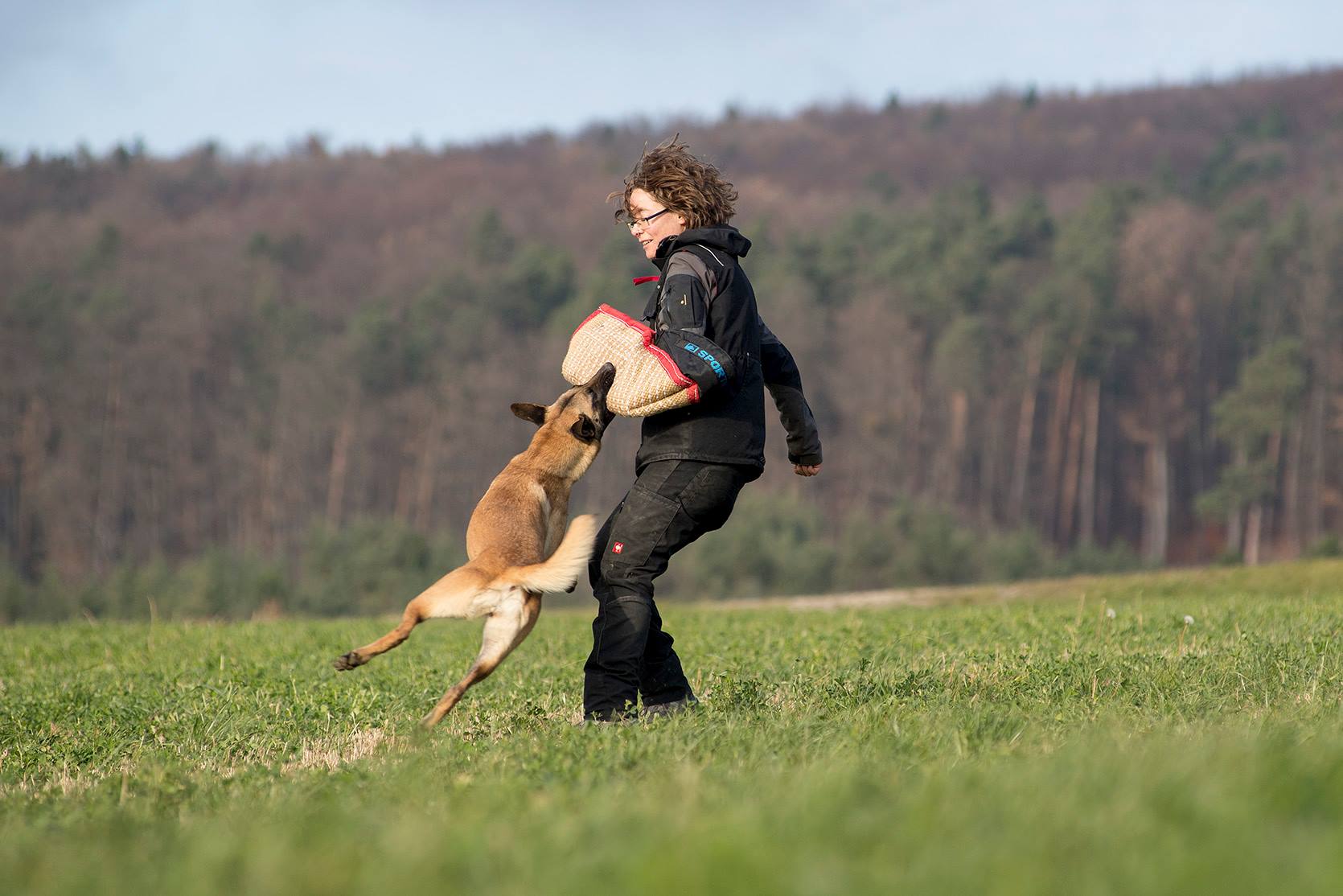
One of my favorite ways of completing my own stress cycles is playful exercise as well: it’s roughhousing with my dogs. Watching 20-something canine kilos barrell towards you, bracing for the impact, and catching them on a bite sleeve is exhilarating. It requires coordination and concentration. It makes me feel strong. I trust, and I am being trusted. Play-fighting within the rules of the game we established is my perfect stress release: I am completely immersed in this activity. I exist in the current moment in a way I rarely do otherwise. I am moving my body and engaging my muscles in a controlled manner. And I am playing with my dog. Give me a 5-10 minutes of this, and life will be better – at least for the next couple hours. The good thing is that I can go right back for another round if needed!
Roughhousing and rolling on the floor with puppy Game (picture by Isabelle Grubert).
The good news, and the bad news
The bad news: life is stressful. Empty out your bucket, and it’s starting to fill again right away: navigating maskless crowds in supermarkets in a COVID world, being late, the Internet is down, and you’re out of coffee … It’s the little things as well as the big ones, and they just keep coming. All of these are stressors. They are conspiring to turn on the faucets that will continue spitting stress-related neurochemicals into our buckets (the stre-ss).
But there’s good news, too: once we know how to, we can empty out our buckets anytime – even when the stress-ors are still ongoing. I can pick up a bite sleeve and play with my dog until I’m out of breath, and have forgotten everything about the things that aren’t going my way. I’ll feel better, and will be able to not worry about it – until the chemicals in my stress bucket reach a certain level again, and it’s time to empty out the bucket again.
Be your dog’s advocate
Unlike us, our dog’s can’t always choose when to empty their buckets. More often than not, the activities they get to engage in are up to us rather than up to them.
Being aware of Game’s stress response is important because it helps me support her: I can set her up for success. For example, the other day, I met a friend in the crowded center, and we were going to walk up a hill. This is the kind of activity I’d usually bring Game on. Not last week: I knew that the stress of being around strangers would outweigh the benefits of moving her body on a leashed walk. I’ve also told a number of people who wanted to be introduced to her “No” over the last couple of days. Game is a dog who generally enjoys meeting new people – but not when she’s already running low on energy. She can’t speak for herself, so it’s up to me to be her advocate.
How about *your* dog?
What clusters of behavior does distress track for your dog? How do you support them when external stressors lower their threshold, and how do you help them complete the stress cycle? Also: how about yourself?
Below: an excerpt of Game’s stress-release fun, and one of our favorite road trip songs: “Lift your / head up …”
PS: Today, as I hit “publish” on this post, it’s more than 5 weeks post surgery. Game is doing great – especially since she’s finally allowed to play tug, and fetch hard balls again!
… is not only a band worth checking out, but may also be your ticket to a relaxing walk with your dog. A few months ago, Denise Fenzi started experimenting with walking the dog in a circle around the handler in order to reduce leash pulling. Her method has since grown into a pragmatic approach that doesn’t only address excitement-based pulling, but also reduces reactivity and anxiety in some dogs.
I experimented with my own as well as my clients’ dogs, and found Denise’s circle method to make an excellent addition to my leash walking toolbox. It’s both simple and powerful, and it lends itself to being combined with and used in addition to other leash training strategies I was already using. Clearly, it needed to be part of the new FDSA class I was working on as well: Out and About already included several leash walking approaches for my students to choose from.
Three of my Gold students chose to use circles on their urban walks and nature hikes. Their dogs were very different, and all three of them uploaded multiple videos of their leash walking assignments. The circle method turned out to be helpful to every one of them. Here’s what I learned from further exploring it with my Out and About students and their dogs while also continuing to play with it in real life:
Most people find it easier to circle on a collar or front-attachment harness than on a back-attachment harness.
If your dog has a hard time allowing you to lead him into the circle, practice giving in to leash pressure at home. This seems to do wonders for the dog’s understanding – especially if you use the leash pressure game to walk your dog in a circle around your own body.
Going back and forth over familiar terrain – for example, walking the same short loop two or three times rather than walking one longer loop – helps highly excited dogs calm down.
If your dog speeds up, trying to get out of the circle and pull as soon as he gets close to his starting point, add another circle immediately. This tends to slow the dog down, and decrease his speed even on the first circle.
If you’re on a trail that’s too narrow for you to get a radius of more than a few inches, walk ellipses rather than circles.
Walk at your normal speed – don’t run just because your dog would like to go faster. Channel his energy into the circles until he has learned to adjust to your walking speed.
If it makes sense for your dog, combine the circle method with food (food scatters; treat magnets; mark/treat for auto check-ins; the LAT game; counterconditioning; eating as an alternative behavior etc.). While the circle method doesn’t require food, treats can make a big difference if your dog doesn’t “just” pull, but is also reactive, fearful or anxious.
Unless your dog is circling, always encourage and allow sniffing. Most dogs find sniffing to be relaxing, and I’ve seen it reduce both pulling and anxiety.
Acknowledge your dog’s checking in with you! You can mark and feed, or simply praise your dog.
Speaking of circles: Denise’s Cutting Corners webinar will be offered for the third time on Thursday, May 23, 2019. Check it out!
Once my dog can stay in their crate for a minute without getting up, I introduce a different kind of reinforcer: a long-lasting chew such as a frozen Kong or a bone. At the 1-minute mark, my crate (or mat) training starts to look very different from building a duration stay for obedience. Once my dog has understood the concept of staying put, I’ll add relaxation to the picture.
Introducing a chew in the crate
Get a good book or your laptop – you’ll need it to entertain yourself! You’ll also need the timer app on your phone.
Send your dog into their crate. Mark and feed in position.
Give them a long-lasting chew such as a frozen Kong, bone, bully stick etc.
Set your timer to intervals between 1 and 3 minutes – you can randomize these or take turns feeding after 1, 2 and 3 minutes respectively.
Hang out near your dog, who should be enjoying their long-lasting chew. Read your book, watch a movie or play on your laptop! Feel free to talk to your dog anytime you feel like it.
Every time your timer goes off, feed a treat.
End the session after 15 minutes by trading the chew for treats. Release your dog.
Phoebe demonstrates this step on a mat. For crate training, just imagine the mat were a crate with the door open. You don’t have to watch the entire video – it’s long and boring, just like relaxing in a crate or on a mat should be for the observer! However, check out the last 30 seconds of this video: Phoebe doesn’t want to leave her mat! That’s the kind of association we want to build to mats and crates!
Transitioning to using your crate in real life
Congratulations! Once you get to this point, you’ve already conquered the most difficult part of crate training! There’s a few tricks that will help you transition from these structured training session to relaxation for longer periods of time, when you’re not sitting next to your dog and with the door closed.
Removing yourself from the picture
Do exactly what you did in the previous step: offer a Kong or bone to your dog and set your timer of your phone to random intervals. The door to the crate should still be open at this stage.
With your dog relaxing and chewing in the crate, move around the room, engaging in tasks such as cleaning, doing the dishes or organizing your bookshelf.
Every time your timer goes off, return to your dog and feed a treat.
End the session after 15 minutes by trading the chew for treats. Release your dog.
What if your dog gets up and comes out?
No big deal. Trade the Kong or other chew for food if they brought it out as well, send them back into the crate and return the chew. If they keeps leaving, go back to the previous step (sitting near the crate rather than moving around the room) for another session. You can also ziptie your chew to the back of the crate so your dog can’t carry it outside!
Closing the door
Set up just like you did in the previous step.
At this point, your dog should be so comfortable staying in the crate that you can close the door after handing them the Kong without making a big deal out of it. Close it!
Set your timer to intervals between 1 and 3 minutes.
Move around the room doing chores.
Every time your timer goes off, return to your dog and feed a treat.
End the session after 15 minutes by trading the chew for treats. Release your dog.
Removing yourself from the room
Set up just like you did in the previous step.
Give your dog a chew.
Close the crate.
Set your timer to intervals between 1 and 3 minutes.
Go about your business in your house – both in the room with your dog and outside the room.
Every time the timer goes off, return to your dog and feed a treat.
End the session after 15 minutes by trading the chew for treats. Release your dog.
Extending the time between bonus treats
Set up like before: Kong, closed door.
Set your timer to intervals between 5 and 7 minutes.
Go about your business in your house – both in the room with your dog and outside the room.
Every time your timer goes off, return to your dog and feed a treat.
End the session after 15 minutes by trading the chew for treats. Release your dog.
Staying relaxed – even after finishing the Kong or bone
Set up like before: Kong, closed door.
Set your timer to intervals between 5 and 7 minutes.
Go about your business in your house – both in and outside the room with your dog.
Every time your timer goes off, return to your dog and feed a treat.
New element: from now on, keep going for 5 additional minutes in every future session – even if this means your dog finishes their chew and has nothing left to do! Build up to the crate duration you are aiming for this way!
Keep feeding the interval treats even after your dog has finished the chew.
Fading the interval treats
Once your dog relaxes in their crate even after finishing the chew, you should be able to stop feeding interval treats. Personally, I like keeping a treat bowl on top of the crate. I’ll just drop one in every once in a while for the rest of my dog’s life.
Fading the chew
From session to session, choose smaller and smaller bones or Kongs with less filling – until all you you need to do is feed your dog one treat when they first go into the crate.
Keep feeding Kongs or other chew delicacies in the crate every once in a while to keep up positive associations with the crate! Anytime I leave my own dogs in their crates for a longer time, they’ll get something special to chew on.