Reflections on my conversation with Marc Bekoff

I just got to have Marc Bekoff on my podcast! We talked about Jessica Pierce’s and Marc’s latest book: A Dog’s World – Imagining the Lives of Dogs in a World Without Humans.

I translated this book to German, and it recently got released by Kynos Publishing. Since I usually stay in touch with “my” authors in the translation process, I grabbed the opportunity to invite Marc on a Zoom chat.

In this episode, I acknowledge the relevance of A Dog’s World to pet dog owners today, and I challenge Marc on the conclusion drawn in the book: that the species dog would survive (or turn into a new species) if all humans disappeared. It’s the latter part that I want to talk about some more after further thinking about the book and our conversation.

Survival in a posthuman world

What I’m still grappling with is the idea that dogs would survive without us. My openion (and yes, this is VERY MUCH an opinion because we can’t test this scenario in a meaningful way) is that dogs would go extinct in a world without humans.

Jessica and Marc believe that many dogs would not only survive, but thrive in a world without us.

Suspension bridge on a trail in Amatlán de Quetzalcóatl, Morelos

Where we come from

Only in the course of this conversation did I realize how different the points of origin of our respective arguments are, and how our respective conclusions followed, perhaps quite naturally, from exactly these anchor points we already had long before this conversation.

Marc’s longest field research project, I believe, was on the lives and behavior of coyotes in Yellowstone National Park. As an ethologist, Marc observes behavior and writes ethograms (a list of observable behaviors and their contexts) about different species in their natural environment. In Marc’s case, these species were primarily wild canids.

Marc is a dog lover who has also spent many days at dog parks, observing the interactions of Boulder’s dog park dogs through an ethological lens. Marc has researched, by reading everything that is available in terms of observational studies, the lives of free-roaming domestic dogs around the world, and observed feral dogs arund Boulder. On the podcast, Marc points out that the ethograms of domestic dogs and wild canids is nearly indistinguishable.

Marc has also lived with dogs: companion dogs who were off leash when Marc was out with them around Boulder, CO. Marc observed the behaviors these dogs would engage in in their off-leash lives. (They were only out and about off leash when Marc was with them – so probably living degrees of freedom similar to my own dog, who is not a free-roamer.)

Taking the similarity of the ethograms, the independence of Marc’s own dogs and a group of feral dogs who would make occasional trips to the dumpster but also hunt outside of Boulder, Marc and Jessica Pierce conclude that there would absolutely be individual dogs – enough to form new wild populations – surviving the demise of the human species.

Suspension bridge on a trail in Amatlán de Quetzalcóatl, Morelos

The anchor point of my ship train of thought is different. I am a dog trainer. The dogs in my life are usually sports or working dogs, or very active companion dogs of high-maintenance breeds, or not so active dogs living with highly sophisticated dog folks who are most definitely not average pet dog homes. I have never had a pure pet dog myself, and neither do most of the folks I work and interact with today. My personal interest and the areas into which I am trying to stretch are behavior analysis, psychology, neurology, and behavioral medicine. I have no degree in any of these fields, but I try and learn as much as I can about them. I also live in a part of the world where many (most?) dogs are homed free-roamers. I love observing them; I consider their life quality high, and I have dedicated a Youtube Channel to them.

When I think “domestic dog,” what comes to mind is not the general pet dog population: I think of dogs who live with geeky trainers on the one hand, and free-ranging dogs on the other hand. I sometimes forget that there are also pet dogs.

When Jessica and Marc think “of “domestic dogs,” I suspect they think of pet dogs on leashes and in dog parks on the one hand and wild canids on the other hand.

What I agree on with Jessica and Marc

I fully agree with Jessica’s and Marc’s conclusions about how the lives of pet and companion dogs could be improved, and how we can draw these conclusions by looking at the behavior of free-ranging dogs today.

The sociability and ability to form groups and packs is something I see a lot in free-roamers, so we’re on the same page there as well. I don’t doubt that dogs will be (variable degrees of) sociable and able to form packs. Free-roaming dogs already do.

Alloparenting also occurs in domestic dogs that are kept in groups when breeding as well as in free-roaming dogs. Again – I have no doubt posthuman dogs could alloparent (and some would do so if they survived).

I don’t doubt that they will hunt solitarily either – I know plenty of dogs who will do so when given the opportunity (these are not free-roamers, but sports and working dogs). What I wanted to be convinced of, however, was the cooperative hunting part – something I’ve never seen and find hard to imagine.

The food resource thing …

I have never – NEVER – seen free-roaming dogs who did not depend on anthropogenic food resources. Even the feral dogs around Boulder that Marc mentions visit the dumpster. That makes me suspicious of whether they could survive if they had to rely on hunting. When Marc’s student saw them hunt cooperatively – did these dogs actually take down prey, or were they just chasing, like many dogs would, without actually killing/consuming? I am not clear about this. Even if they killed, but did not consume – I don’t think we could call that cooperative hunting. For hunting to be hunting, doesn’t it need to end in eating the prey? (I don’t know; I’m sure there is a definition though.)

What even is a feral dog?

A feral dog is a domestic dog who isn’t tame. A dog like this will have a bigger flight distance than other free-roamers. I have seen very few feral dogs in my life, and they usually look as if they were starving because they are too scared to visit the dumpster on a regular basis.

How do feral dogs happen? I suspect a truly feral dog has missed out on any and all human contact during the sensitive socialization period, as a very young puppy. This can happen if a free-roaming dog has puppies away from their home – say in a forest where humans rarely go -, and the dog’s humans don’t look for or don’t find the puppies.

Why are there so few of them? Because most of them will die! Your chances of survival are much higher if you are not feral and can access human handouts and the waste we generate.

Wouldn’t there already be feral dogs everywhere today if it was easy to be one?

I also suspect that if dogs without humans were a realistical scenario, we’d already see successful secondarily wild dogs who have no contact with humans whatsoever, and who hunt cooperatively. As far as I know (and I may be totally wrong – please comment with resources if I am!) these dogs do not exist today. (It has been argued that Dingoes are not feral dogs, but true wild canids. That said, I have read that there are secondarily wild dogs on the Galapagos Islands. I haven’t had time to look into them yet. If these dogs were truly feral and descended from the domestic dog, and were not dependent on any anthropogenic food resources – this would be a convincing argument for me that under specific and rarely occurring circumstances, the species dog might be able to survive in certain locations in a post-human world.)

The posthuman dog future I imagine, based on my anchor point

From my current point of view, given the dogs I see, I think most pet dogs, if left loose in a world WITH humans, would make decent free-roamers and enjoy the trash we leave behind as well as our handouts. They’d have social relationships etc. Working dogs like mine would also enjoy killing all the livestock around town (which would result in them getting poisoned or shot).

If I imagine the fate of dogs in a world without humans, these same dogs would eat all the trash we left behind, and then feast on the livestock (easy prey) as well as urban rats and pigeons (also easy prey). And then, they’d die, mostly in the transition dog generation (the generation of dogs who still had human contact).

I have a hard time imagining dogs learning to hunt cooperatively in the little time they have after all the livestock and trash are gone. Most of them will die, and the few that survive … Will they be neutered? In that case, they’re in a genetic dead-end street. Will enough of them be both intact and able to hunt cooperatively? I really doubt it because the free-roaming dogs today – remember that’s about 80% of the world’s dog population! – have been selected (naturally, if you will, by humans killing dogs who kill livestock) to NOT hunt. I’m not sure if “average pet dogs” will be able to hunt. Working dogs certainly would (solitarily at least), but there are so few, and they are so far apart, that they may never meet each other. And if you’re a working dog (other than a terrier), you may be too big to sustain yourself on the kind of prey you may be able to catch by yourself once the livestock is gone. And the livestock will be gone because it will either die without us or be killed by transition dogs.

A thought experiment

I just googled, and according to a dubious source (but that’ll do for my thought experiment), a 100g jack rabbit contains 173 calories. Now let’s see how many calories an adult dog needs. Say Game’s RER is 650, and if she had to stustain herself by means of hunting, her caloric needs would be 650 x 2-5, which, if I’m calculating this correctly (and I may not), makes 1295 caloiries. That’s a lot more than a single rabbit. If Game had to sustain herself on jack rabbits she’d have to catch 1295 divided by 173 makes 7.5 jackrabbits every day. That is A LOT of rabbits. I cannot imagine a world in which my dog would successfully catch this many rabbits on a daily basis.

We’d also have to look at the energy spent on hunting a rabbit. Since this calculation is based on the caloric needs of an active working dog, let’s say if all of Game’s hunts were successful, she would meet her caloric needs every day with 7.5 rabbits. But she is unlikely to succeed every time. So how many calories would she loose with each rabbit that got away? How many calories does it cost to hunt one rabbit? (I do not know.)

In any case, if two rabbits, after a high-energy chase, got to safety, Game would be losing rather than gaining calories. Consequently, that very same day, 7.5 jack rabbits would not be enough anymore – she’d have to successfully hunt, kill and consume, say, 9 to make up for the energy spent on the ones who got away. This is even less likely because every hunt is tiring, and hunts #8 and #9 have a smaller chance of success because of it.

Dogs don’t need to eat every day. So Game could go a while without eating 7.5 rabbits a day and still do okay. She’d gain experience hunting with every attempt – but she’d also spend energy on every attempt, successful and unsuccessful. After several days of not eating, there may be peak performance due to peak motivation, but then that performance will go down unless Game was highly successful at peak motivation. So by the sheer amount of rabbit hunting required, I don’t think it is realistic for a dog of Game’s size to survive as a solitary hunter. Most solitary hunting canids are smaller than she is. (There are solitary coyotes or foxes, for example, and they get by hunting bunnies and rodents (and, given the contents of the scat I’ve seen around Guanajuato, lots of cactus fruit). Game is heavier than they are.)

So Game would likely have to go after larger prey, and large prey can often only be overwhelmed by means of cooperative hunting. Will dogs really figure that out in time? I have my doubts. The largest prey animal I know fairly well are (Austrian) deer, and they are fast and flighty. It’s certainly possible to hunt them cooperatively, but I imagine it would require a lot of practice. And transition dogs may not have that time. Especially because, being dogs, they would not gather to brainstorm for a future of hunting while there still were anthropogenic food resources. Instead, they would – evolutionarily myopically, if you will – focus only on these easily accessible resources until they ran out of them. (Just like we humans and our fossil fuels, really. We’ll only implement meaningful changes once we’re past that climate change tipping point, and at that point, our changes will make little or no difference for many folks around the world, because the places they live today will have become uninhabitable for our species. This is an opinion, not a fact, and I would love for it to be wrong.)

Suspension bridge on a trail in Amatlán de Quetzalcóatl, Morelos

There may be dogs (smaller than Game) who can sustain themselves on bunnies and the like. But will they happen to be close enough to another transition dog to breed? Maybe in rare cases. Will their puppies survive? Few will, I assume, because the survival rate of wild canids and free-ranging dogs is very low.

The anthropogenic world as the dog’s niche

After thinking about all of this some more, my opinion still is that dogs won’t survive without us – even though during the conversation itself, I was trying to be open to the possibility that they would.

I would not say that the ecological niche of the domestic dog is the human household (80% of the world’s dog population is free-roaming), but I would say that their niche is the anthropogenic world. And this niche will disappear with us. I’m not optimistic they’d adapt to a new niche fast enough … even if they all happened to be free and outdoors when we humans disappeared from the planet. I think of their niche as the anthropogenic world in the same sense I think of this being the niche of urban rats and pidgeons. In my opinion, all three of the above would die after eating all the resources we left behind when disappearing. I suspect this will be the fate of everyone who is considered a Kulturfolger animal in German.

I also realize that this very much is an opinion based on my background, my work and my interests. I can absolutely see how a different background, like Marc and Jessica have it, will lead to completely different conclusions!

Why does everything have to be so annoyingly relative?

Coming at a topic from different angles can lead to misunderstandings or talking past each other – I think this, too, happened to us. And it just goes to show how difficult it is for folks from different fields, who have different jargons they take for granted, to understand each other! For example in my conversation with Marc, this happened when Marc used the word “engram.” This term also appears in A Dog’s World (once). I had never come across it before, and researched a little when translating the book. Conveniently, the German equivalent is “Engramm.” It’s basically the same word with the same Greek root. In the book, Marc writes:

“We’ve provided a range of ideas about what the evolutionary trajectories of posthuman dogs might look like. A recurring theme has been trying to understand and appreciate the ancient impulses and memory traces that still lurk in dogs’ brains—the indelible engrams that still influence what they do and how they feel and which will shape how they do without us.”

(Page 157 in my copy of the publisher’s PDF)

I looked up the meaning of the term when I was translating, but I can’t say I feel like I understood it. The way Marc uses the term, it seems to refer to a kind of collective memory of generations long past. Something that isn’t “active” – basically something that isn’t “online,” but could theoretically be brought online again by life circumstances. From digging into the topic a bit, it seems to still be controversal whether engrams actually exist.

On the podcast, Marc used the term engram again, and I asked whether this would work like a modal action pattern. (“Model action pattern” is in my active vocabulary; I know its definition: it is a behavior chain that is released by a certain stimulus and usually displayed through to the end (it is difficult to interrupt). It hardly varies from one occasion to the next or between individuals. Modal action patterns are more like a highly complex reflex you don’t consciously control than advanced and varied social communication. Modal action patterns are NOT offline, but very much online, and they are innate. An example is the hunting sequence of the wolf: search – eye-stalk – chase – grab-bite – kill-bite – consume. Another example is the herding behavior of the Border Collie, which is a modified hunting sequence: it goes from search to eye-stalk to chase, and ends there.

Anyways, so I asked Marc whether an engram was like a modal action pattern, only that it would be brought online by necessity rather than already being online and simply being displayed when a certain stimulus was present.

Marc ended up basically giving me the definition of a modal action pattern. But whatever an engram is, it can’t really be a modal action pattern – unless there is a field (psychology? ethology?) that uses “engram” in the way behavior analysts use “model action pattern,” and the terms actually mean the same.

But cooperative hunting – not hunting, but the cooperative part – can, by its very nature, not be a modal action pattern. Modal action patterns are rigid and hard to change, and cooperation is flexible and adaptive. So Marc didn’t answer my question, and I don’t think that was on purpose, but either because Marc isn’t familiar with the way “modal action pattern” is used by dog trainers or because I didn’t manage to formulate my question clearly! Argh! Or maybe I’m using an outdated definition of modal action pattern!

Cooperative hunting is by its very nature varied because different individuals have different roles. In a word: I still don’t understand what exactly an engram is. In both a German article and the English Wikipedia article, it seems to be about memories of something that happens in your lifetime, and (maybe) the physical location where these memories are stored in the brain. But this is not the way Marc uses the term, as far as I can tell: cooperative hunting can’t be an experience being remembered by an individual dog who has never had the experience of hunting cooperatively.

I don’t think it has been shown that it is possible to “remember” the social behavior of our very distant ancestors. Sure, we are influenced – both through social learning and genetics and in-utero/in-petri-dish experiences by biological relatives and the folks around us. But these are not distant ancestors! So I am still confused about the engram explanation of cooperative hunting, and this is frustrating to me. We were discussing a topic we were both passionate about (dogs), and we didn’t speak the same jargon. I’m used to talking to behavior folks and dog trainers, and we have a shared vocabulary! Marc is probably used to talking to ethologists or pet folks. With the former, there is a shared jargon (which I do not speak), and the latter probably don’t ask the kinds of questions I ask. Anyways, if someone reading this can explain the meaning of “engram” to me, please leave me a comment!

Communication is fucking hard!

In the end, this is probaly the take-away from the conversation I find most fascinating: it is difficult to understand each other if you don’t have a shared vocabulary! And it is really the anchor point of our experience our our field that informs our opinion! When you start with wild canids and compare their ethograms with domestic dogs, you’ll conclude that because they are very similar, they will also be able to hunt cooperatively. (At least if you are Jessica Pierce or Marc Bekoff.)

When you start with working dogs (and know little about wild canids) and observe free-roaming dogs who depend on anthropogenic food resources, you don’t think they will master cooperative hunting. (At least if you are me.)

Suspension bridge on a trail in Amatlán de Quetzalcóatl – and Game’s tail!

And really, this is a metaphor for so many things in life! Depending on where we’re coming from, we’ll find strong arguments to support our respective opinions. (Yay, confirmation bias! Yay, anchoring effect!) We may be fully convinced of them. And yet: some of them are opinions, not facts. It’s both hard and worth striving for to hold both these truths at the same time: on the one hand, our convictions themselves on the basis of which we are who we are in this world. And on the other hand, the fact that some of these convictions will always be opinions we can’t currently fact-check. And that’s fine. Complicated – but fine. Doesn’t make them less valid. But sure makes everything a whole lot more complex.

There are facts, of course. I am not a relativist. I see facts, and will fight for them, especially if they are facts I care about on a deep and personal level. But whether or not dogs would survive in a world without us? That’s not something we will ever be able to know.
Resources for those who want to take their dog training skills to the next level

Last updated in November, 2025.

A friend (who already knows quite a bit!) asked me where to learn more about dog training without spending a truckload of money they don’t have, and I started putting this list together. It’s not complete (there are so many great resources out there!), and the order is semi-alphabetical: I try alphabetizing it, but I occasionally forget what letter comes when. I have not read every single post, listened to every single podcast episode or seen every single video on the Youtube channels below. If a resource is mentioned in this post, it is because it has caught my attention and I have found some of its content thought-provoking. I’m not familiar with every single piece of information the trainers linked to below have put out into the world. Even if I agree with some of their content, I don’t usually agree with all of it because I’m human, and different humans see things differently! There are many resources in this list that include opinions and approaches I disagree with or wouldn’t use myself, but still found useful and informative. This list is not restricted to any particular training philosophy. Go have fun!

Youtube channels

Adventure Dogs (some of my stuff)
Free Ranging Dogs (occasional videos about body language and canine behavior)
Ivan Balabanov
Kikopup (Emily Larlham)
Larry Krohn
Leerburg Dog Training (Michael Ellis, Forrest Micke, Ed Frawley et al.)
Nate Schoemer
Next Level Dogs (Jay Jack)
Pat Stuart
School of Canine Science (Nando Brown, Jo-Rosie, Dean Nicholas)

Podcasts

Animal Training Academy podcast (Ryan Cartlidge)
Bad Dog Agility (Esteban & Sarah Fernandezlopez )
The Bitey End of the Dog (Michael Shikashio)
The Boneyard (Dave Kroyer)
CAAWAT (Constructional Approach to Animal Welfare and Training) (Sean Will & Maasa Nishimuta)
Canine Conversations (Robert Cabral)
The Canine Paradigm (Glenn Cooke & Pat Stuart)
Drinking from the Toilet (Hannah Branigan)
Cog Dog Radio (Sarah Stremming)
Consider the Dog (Tyler Muto)
Dog Pro Radio (IACP, i.e. International Association of Canine Professionals)
Dog Talk with Dr. Jen (Jennifer Summerfield)
Dog Training Conversations (Jay Jack & Chad Mackin)
Farm Dog (Aaron Steele)
Fenzi Dog Sports Podcast (Melissa Breau)
Fenzi Food for Thought (Denise Fenzi)
The Functional Breeding Podcast (Perry Hekman)
GRC Dog Talk (Jay Jack)
Gun Dog It Yourself (Nick Adair)
K9 Conservationists (Kayla Fratt)
K9 Detection Collaborative (Stacy Barnett, Robin Greubel, Crystal Wing)
Learn, Laugh, Bark (Jake Schneider)
A Life of Dogs (Jason Purgason)
Life with Your Dog (Panos Anagnostou & Luke Badman)
Not Another Dog and Pony Show (Lauren Fraser & Matthias Lenz)
Not Truly Aggressive (Dylan Jones & Kimberli Weeks)
Our One Wild and Precious Lives (and our dogs) (yours truly and the anarchocanines)
Pit Bull Awareness (This podcast seems to only have two episodes, but both are worth listening to!)
Police K9 Radio (Gregg Tawney & Tim Wiesling)
Shaped by Dog (Susan Garrett)
Something to Bark About (Chad Mackin)
Training without Conflict (Ivan Balabanov)
Working Dog Radio (Ted Summers, Eric Stanbro, Alesha Brandt)
Yolopup

Podcasts in languages other than English

Knackfrosch & Gummistiefel (German language; Eva Berginc & Florian Schneider)

Blogs

Adventuredogsanarchy (Caden Cristopher Anarchy—the website you’re on.)
The Collared Scholar (Meagan Karnes)
Deb Jones
Denise Fenzi
Dr. Jen’s Blog
Eileen Anderson
Fenzi Dog Sports Blog (different FDSA instructors and guest posts)
Kayla Fratt
Patricia McConnell
Sarah Stremming
Shade Whitesel
Sue Alexander
Tania Lanfer

Facebook (lots of interesting public content)

Denise Fenzi puts out lots of public high-quality dog training content
Dylan Jones
I publicly post free dog-related resources too (some of the time, when I’m in an FB mood)
Larry Krohn

Other stuff

Caden Cristiopher Anarchy—free stuff
Consider the dog—free video section (by Aimee Sadler, Blake Rodriguez, Brian Agnew, Cheri Lucas, Forrest Micke, Robert Cabral, Sara Brueske, Tylor Muto et al.)
One trainer’s way of introducing e-collars to pet dogs (Ted Efthymiadis)
Free webinar on conservation dog training by Kayla Fratt of K9 Conservationists
Free webinar by Marco Ojeda and me on the free-roaming dogs of Mexico and Guatemala
Free presentation by Barbara Heidenreich: the secret life of if/then contingencies
Growing up FDSA (free e-book)
Jay Jack’s foundation training plan—lots of free information and example videos outlining Jay’s approach


If you have your own recommendations for FREE resources, leave them in the comments! I’ll remove advertising and recommendations for paid content. Apart from that—go ahead and share away! Add a link, what type of resource it is, and why you are sharing it!

The 3 Ts of working with marker cues

There are three things we’ve seen FDSA students struggle with over and over again – even advanced students and excellent trainers! We’ll call them the 3 Ts: Timing, Tautology and Treat Placement. This post gives you an overview. If you’re going to delve further into marker training for precision behaviors, the 3 Ts are something you want to print out and tape to your fridge!

Timing

The marker cue needs to happen before you deliver the primary reinforcer.

Example: click – pause for a split second – treat.

Tautology

You want a single marker cue before the primary reinforcer.

Example: “Get it” is my marker cue for tossing a treat for the dog to chase.

“Get it!” – pause for a split second – toss treat.

Do not add a click before or after your verbal marker! “Get it” itself is your marker – and it’s the only one you need.

Treat (or toy etc) placement

This is a subcategory of timing related to location specific marker cues (LSMs). If you use location specific marker cues (i.e. you want a different marker cues to indicate different modes of treat or toy delivery), you MUST say your marker cue before reaching into your treat pouch or moving your toy. “Otherwise,” to quote Shade Whitesel, who says it better than I ever could, “you are just teaching the dog that 5 different marker cues all mean the same thing: look at the hand to see where and what you will get.”


Whether the 3 Ts are obvious or not in any exercise or class you are working on; whether they are being addressed directly or lingering in the background: they will always be by your side. Keeping an eye on them will make you a better trainer, and take your dog’s understanding of what you are trying to teach them to the next level!

The Puzzle Week, Part 26: Resource Guarding

I generally have a few toys out – if I haven’t, Game will turn my shoes into toys.

Resource guarding incident #1: toys


On day #1 or #2 of the Puzzle week, I observed a resource guarding moment in Puzzle: she was guarding a toy from Game. In such a young puppy (supposedly 8 weeks; maybe a little bit younger), this is a red flag behavior for me. I happened to catch it on video. Let’s look:

… and analyze! Btw, I’m pretty sure what’s running in the background is a recording of Jennifer Summerfield‘s excellent webinar on behavioral medication for dogs.

01:02 Puzzle, who hasn’t played with toys before, shows interest in the Hucker as soon as Game leaves it alone to go for the red ball on a rope. Okay – nothing wrong with this. (Stimulus enhancement causes her interest.)

01:17 Now Puzzle has the Hucker, but Game and I are interacting with the other toy, which makes that one more enticing.

01:37 Game has dropped the ball, and Puzzle comes over to take a closer look at it. (Stimulus enhancement!)

01:44 “Okay,” says Game, “Let’s see what you’re up to, little puppy!”

01:48 Game likes tugging with other dogs, so when Puzzle takes the rope, she picks up the ball …

01:49/50 It’s not entirely clear what is happening from this angle. Puzzle certainly stiffens and stares at Game, and Game lets go of the ball. (Is it because of Puzzle’s stiffening/stare, or was she going to do it anyways? We can’t know for sure.)

01:51 Game decides to get the Hucker instead – it’s currently not being used by Puzzle, so why not pick it up (and maybe bring it over to me)?

01:51/52 The moment Puzzle realizes Game is going for the Hucker, she lunges at her.

01:55/56 Game is unsure of how to handle the situation – she’s a puppy, after all. In her world, puppies have more leeway than adult dogs. You can see her do a lip lick (my interpretation: dilemma/self-consciousness/self-soothing).

02:01 Game stays calm and relaxed and gives Puzzle time to calm down as well.

02:03/04 Another lip lick. Puzzle is still feeling a bit guardy.

02:20 Game yawns … she’s not entirely sure how to handle the situation. Yawns can be like looking at your cellphone in order to let someone else in an elevator know that you’re neither creepy nor particularly interested in standing close to them.

Game is not afraid of Puzzle. If Puzzle were an adult, she would not put up with resource guarding – but she’s a puppy, and in Game’s world, that is different.

Because I know Game and can read her well, I keep filming rather than intervening. I knew nothing bad would happen despite their size difference. (This post is NOT a recommendation of how to handle resource guarding among the dogs in your own household!)

02:24 Enough time has passed, and Puzzle is now on the other side of the crate door. Game picks up the Hucker again to go about her day. (Good girl, Game! You’re awesome.)

Let’s pull out one detail I find particularly interesting in this video: Puzzle’s mixed feelings about the situation she’s getting herself into. Puzzle is experimenting with the resource guarding behavior rather than doing it out of habit. Let’s watch a stretch in slow motion:

Watch the slow-motion video a second time, and then go back to the first (real time) video. Can you make out all the body language details from the slow-mo video in real time?

How do behaviors like resource guarding develop?

We know that most behaviors have heritable components – heritability being the differences of a trait within the individuals of a population that depends on genetics. So we have both a genetic component and an environmental component that will determine the final behavioral phenotype (the individual’s observable behavior).

Let’s assume (for argument’s sake, not because this is necessarily the case) that Puzzle has never tried resource guarding before. But she’s got a combination of genes that inspire her to give it a try – even though she doesn’t exactly know what she’s doing. There’s an environmental trigger (Game wanting the Hucker Puzzle had before) that pushes Puzzle into the behavior.

Several things can happen at this point, depending on the other dog’s reaction:

  • If the other dog gives up the toy, the guarding behavior will be reinforced (that’s the operant, environmental part of the equation: behaviors that are being reinforced will happen more frequently in the future).
  • If the behavior doesn’t work (it has no meaningful consequences), it may be tried again in the future – maybe slightly differently, maybe in somewhat different circumstances.
  • Or it may not be tried again in the future; maybe it was just a haphazard one-time attempt: the behavior extinguishes.
  • If the behavior is punished by the other dog (if Game reprimanded Puzzle), it should decrease or disappear in the future.

Puzzle is very young, so at the point that I took this video, I’d have predicted that she’d need several extinction or punishment experiences before the synapses necessary to keep the behavior in her repertoire would be pruned.

Fast learning

You can see how fast learning happens in real time in this very video: the first hard stare Puzzle gives Game at 01:49 (first, original speed video)/00:09 (second, slow-motion video) works: Puzzle’s hard stare is being negatively reinforced by means of Game moving away. Puzzle quickly tries the hard stare again at 01:59 (first video at original speed)/03:02 (second, slow-motion video)! When it doesn’t work, she escalates to snapping. (If this had been reinforced more than just once before before, we’d call it an extinction burst.)

Resource guarding incident #2: Chrissi

Apart from this moment with the toy, there was only one other resource guarding incident Puzzle displayed (which surprised me; after this one reaction, I expected her to be quite guardy in general). The second incident happened also on the first or second day Puzzle stayed with us. She was curled up on my lap while I was working on my laptop. Game came over to see what was up, and Puzzle snapped at her. Again, Game stayed perfectly calm. (“Eyeroll. Puppies.” Also, Game rocks!)

For me as a dog trainer who has seen owners struggle with resource guarding, both these behaviors are red flags when they show up in young puppies. I thought to myself, “Good thing I’m not going to keep Puzzle.” But – and here’s the really interesting thing! – after these two incidents, NO more resource guarding happened the entire time Puzzle stayed with us, or afterwards, when I had returned her to her family, but picked her up to let her spend a few hours at my place several times a week. I conclude that my initial assessment (resource guarding in young puppies is usually a bad sign for multi-dog households) was not the case for Puzzle.

If I were to anthropomorphize (okay, let’s stop kidding ourselves; this is me full-on anthropomorphizing): as soon as Puzzle learned that she could trust Game, she had no reason to guard resources from her – neither me nor toys nor food.

Trust

What a can of worms! How can we even operationalize “trust”?

Let’s start by operationalizing a behavior that is not trust-based (because that’s easier to define): Resource guarding is a behavior resulting from the belief that if you share something, you will lose something. (In the case of dogs, the thing they are unwilling to share is the same things they are expecting to lose. In humans, the thing they are unwilling to share could be a secret, and the thing they are afraid of losing could be a connection (a friendship, a marriage, a fight).

Trust, then, is the belief that sharing something will not result in its loss. Trusting behavior results from the belief that sharing something (a toy, food, a secret) will not result in a loss (of toys, food, or connections).

A dog who lets no one near their food is resource guarding. So is the human who leaves out the fact that they have kids or are divorced on their Tinder profile. Only once trust has been built (either systematically or organically) can the food or facts be shared.

To work or not to work on resource guarding

If I had planned to keep Puzzle, I would have prioritized resource guarding and systematically worked on it. Since I was not going to keep her, I didn’t worry about it, and worked on other behaviors I wanted to video instead. The fascinating thing: the resource guarding completely disappeared all by itself. Except for the two instances on days #1 or #2, there was no more guarding – ever. Puzzle’s confidence around and trust in Game grew (anthropomorphizing again, I know). In the video below – which is from the last full day she stayed with us – Game steals her tennis ball, and it’s all good anyways. (I’m not saying you shouldn’t work on resource guarding with your own puppy. You absolutely should! I’m just sharing the Puzzle Week story.) After a week with Game and I, Puzzle had become a relaxed house dog who was able to roll around the floor, mostly peed outside, slept through the night, and shared toys with Game.

Resource guarding in free-roaming dogs

Maybe a slight tendency to guard is a selective advantage for free-roaming dogs such as Puzzle and her parents. I’m saying this because I’ve seen it in several free-roamers-turned-pets-as-adults I’ve worked with as a trainer in Guatemala, and because I’ve seen it in free-roamers I’ve observed in the streets. Not in all of them – but definitely in a larger percentage than I’d expect to see in the pet dog population.

Here’s an example of an adolescent Husky mix displaying resource guarding behavior over food:


Wheee, that was a novel! Two more Puzzle posts to come (unless I think of more). Until then: happy training, y’all!

~~~~~~

For more dog training tips and videos, join Chrissi’s April class at Fenzi Dog Sports Academy: Out and About. Registration is open now, and class starts on April 1st. We’re sold out at the Gold level, but there are still Silver and Bronze spots available! Come join us – it’s going to be fun!

The Puzzle Week – Part 21: Social Learning

I used to call dogs learning about social interactions from other dogs “social facilitation” – but I just learned in Kristina Spaulding’s excellent Fundamentals of Ethology course1 that this not technically the correct term! Turns out that social facilitation does not meet the criteria of social learning: it just means that a certain behavior increases in animal A when animal B is present. When B is not present, animal A does not show the same increase in behavior. No learning has taken place!

So … what is social learning?

What, then, is social learning, exactly? And what’s the correct term for the interaction I used to call social facilitation? Let’s see. Social learning is learning by means of observing others. Kristina (again, in her fantastic Ethology course, which you should definitely take the next time it runs) refers us to a definition by Wynne and Udell2. They have three criteria for social learning:

  1. The behavior is not innate – it must be learned.
  2. It must be learned in a specific way: by means of social transmission.
  3. As a result of the learning process, the behavior also occurs in the absence of the demonstrator.

There are four kinds of social learning: imitation, emulation, stimulus enhancement, and local enhancement. Note that social facilitation is not on this list: while there is social transmission, a socially facilitated behavior does not occur without the demonstrator being present.

What is social facilitation?

Dancing might be an example of sopcial facilitation: I’m not into it. But if a friend convinces me to go out, I’ll dance if they do (preferably after having a beer or two). However, I won’t dance in the absence of said friend. Having gone dancing with my friend will not cause me to go back to the music venue, and dance on my own, or with other people. Once my friend has gone home, so will I, and I’ll be glad to go back to not dancing. I’d venture my dancing meets the definition of social facilitation, but not the definition of social learning because it does not occur in the absence of my friend, the demonstrator.

Back to social learning!

What are the 4 types of social learning?

Imitation

Imitation is a goal-directed behavior resulting from the observation of another animal. The learned behavior replicates either the motor pattern or the form of the behavior.

Say an alien just landed on earth and sees a human drop a coin into a coke machine, and then drink a refreshing beverage. The alien, who has never encountered a coke machine, then also drops a coin in the machine and enjoys a soda. Going forwards, the alien is able to get a coke whenever they want (as long as they have access to coins and coke machines): through imitation, they have learned to work coke machines the same way humans do. If they used their hands to drop coins into the slot, we’d call it true imitation (they imitated the motor pattern). If they used their trunk to drop cpins into the slot, we’d call it functional imitation (they imitated the form of the behavior, but not the exact motor pattern).

Emulation

Emulation is also a goal-directed behavior resulting from the observation of another animal. However, unlike imitation, the form or motor pattern of the behavior isn’t directly imitated. Instead, the observer just recognizes that a solution to a problem is available. Let’s look at a different alien. They watch a human drop a coin into the coke machine, and out comes a refreshing beverage. Yummy! Looks like it’s possible to get cold drinks from that big box with the Coca Cola logo on it! The alien now smashes the coke machine with its trunk, pieces of broken glass and plastic everywhere, and in the midst of it all, there are bottles of cold beverages, which the alien now enjoys. Assuming that I understand things correctly (no guarantee there), this is emulation. When the alien encounters another coke machine in the future, even if there’s no human present to demonstrate the coin-inserting action, the alien will know that there are likely cold beverages in it, and, if thirsty, will smash it with its trunk to gain access to it.

Stimulus or local enhancement

Animal A’s behavior causes animal B to notice an environmental stimulus, or a particularly interesting spot in the environment.

Dog A sees a cat and stares at it – dog B sees dog A staring at something, and follows their gaze – now dog B also sees the cat, and stares as well. Ta-da! Stimulus enhancement!

Dog A sniffs a certain spot. Dog B notices dog A’s interest in said spot, and heads over to sniff it as well. Ta-da! Local enhancement! Look how easy I’m making this sound!

Let’s clear up my former misuse of the term social facilitation!

So what do we call a situation where animal A observes animal B’s interaction with animal C, and doesn’t only copy their behavior right then and there (imitation), but learns something for the future? What if dog A is shy towards other dogs, but, after observing dog B’s confident interactions, becomes less shy themselves, even in B’s absence? Well, we’ll just call it social learning. Plain and simple.

If A copied a specific play move of B’s, we’d call it imitation (especially if it wasn’t an innate play move, I suppose). If A learned that it was possible to get strange dogs to play (there is a solution), but came up with their own way of initiating play (different from B’s play style), we’d call it emulation.

Once A is confident around other dogs, they might notice a potential playmate after B does, and then initiate or join the fun: stimulus enhancement! In case of doubt, just call it social learning.

And what the heck is social contagion?

Social contagion is a subtype of social facilitation. It is not social learning. In social contagion, observing a behavior causes the observer to engage in the same behavior – without knowing why they are showing the behavior.

Maybe this is social contagion? In any case, it’s hilarious:

Maybe this is social contagion, too! Game is chasing something to fetch it. Puzzle doesn’t know why she is running – she just does what Game does:

What about social support? Yours truly has been throwing that term around, too!

Indeed, I probably have. It’s such a lovely term, isn’t it? Social support. I want to give and receive it from my friends! I want to bathe in it! I want to be socially supportive of my dogs! That said, I don’t think social support is an ethological term. Assuming there is no agreed-upon ethological definition, it won’t serve us in the analysis of dog/dog interactions. It’s a nice buzzword though, so I might keep it around to spice up my paragraphs when its meaning is clear from the context. In any case, since you asked, I looked up its definition in the APA dictionary of Psychology. According to them, social support is

the provision of assistance or comfort to others, typically to help them cope with biological, psychological, and social stressors [my emphasis]. Support may arise from any interpersonal relationship in an individual’s social network, involving family members, friends, neighbors, religious institutions, colleagues, caregivers, or support groups. It may take the form of practical help (e.g., doing chores, offering advice), tangible support that involves giving money or other direct material assistance, and emotional support that allows the individual to feel valued, accepted, and understood. […]”3

The first sentence is useful for observers of canine behavior. The rest is anthropocentric, and irrelevant for our purposes.

Where are all the puppy videos?

I know, I know, you’re here to watch puppy videos, not to get hung up on terminology. But I want to get better at using the correct biological terms for the situations and encounters I’m describing. Explaining them to other people and making up examples is my favorite way of remembering stuff. So here you go! All mistakes and all misleading explanations and examples are my own, and not Kristina Spaulding’s. She actually knows what she’s talking about, while I’m only just learning. As Brené Brown would say, “I’m here to get it right, not to be right.” Feel free to point mistakes out to me (kindly and constructively, because that’s how we do things around here!). And if you are hungry for more geeky ethology, check out Kristina’s classes on her website and at the IAABC foundation.

Alright – back to the cute puppy videos! My next post is going to have lots and lots of dog/dog socialization videos. I promise! To keep this fun, we’ll be playing a game! After reading this post, I want you to tell me what you see in the upcoming videos: social learning? What kind of social learning? Social facilitation? All or none of the above? Hang tight – my next post is coming soon, and it will be gameshowesque.

Sources

(1) Spaulding, Kristina. Fundamentals of Ethology. IAABC Foundation, January 2022. (Will be running again in May – don’t miss it!)

(2) Wynne, Clive D.L and Udell, Monique A.R. Animal Cognition: Evolution, Behavior & Cognition. London, Red Globe Press: 2020. (Note that I have not read this book, but I believe this is the resource Kristina Spaulding is referring to.)

(3) “Social support,” in APA Dictionary of Psychology. Accessed March 9, 2022.

The Puzzle Week – Part 19: Socialization Science, and a practical Approach

I’ve written about socialization before, but it’s been a while: I haven’t raised a puppy since Game was little. And she’s turning 5 this year! It’s hard to believe how time flies.

I’m not going back to see what I wrote when I raised Phoebe, Hadley, Grit, and Game. I’m sure my opinion about socialization has changed since then – it’s constantly evolving as I/we dog trainers learn new things.

The sensitive socialization period

I’ll define socialization as introducing a puppy to the stimuli they will encounter in their adult life. Ideally, this introduction will happen during their sensitive socialization period. It is currently believed that the sensitive period lasts from 4 weeks (the age when puppies first leave their nests; Scott & Fuller1) to approximately 3 months. The most important part of the socialization period, says Jessica Hekman2, happens before the age of 8 weeks. During the socialization period, the puppy’s brain learns what stimuli are stressors, how much stress hormones should be released in response to these stimuli, and how long the stress response should last.

While dogs can still learn to tolerate or even like new things later in life, one of the reasons the socialization period is so important is that puppies are much better at generalizing at this age: meet one or two friendly small dogs? Deduct that all small dogs are friendly! Meet one dark-faced, pointy-eared dog – assume that all pointy-eared, dark-faced dogs are friendly. If they met the same kinds of dogs for the first time later in life, they might, in contrast, learn that this particular dark-faced, pointy-eared dog is friendly, but all other dark-faced, pointy-eared dogs are potentially still evil spawns.

I love Jessica Hekman’s image for the socialization period being the time when the on-switch (what turns the stress response on?), volume setting (how intense is the stress response going to be – i.e. what amount of stress hormones will be released?) and off-switch (when should the stress response end/how quickly should the dog recover from the experience) are being set.1

Interestingly, at a very early age – the so-called stress hyper-responsive period – , animals don’t show a stress response at all. Their brains do not yet make stress hormones in response to scary stimuli! That’s another reason early socialization is crucial: puppies show no fear response to scary stimuli before 5-7 weeks of age. Therefore, a puppy that just left the nest around 4 weeks of age is MUCH more likely to form positive rather than negative associations to the people, dogs, and objects they encounter.1 Once the puppy is 7 weeks old, making positive associations to new stimuli becomes significantly harder: suddenly, cortisol is part of the picture!

Genetics

When the fear response first appears varies between breeds. For example, German Shepherds start experiencing fear around 5 weeks of age. Cavalier King Charles Spaniels only start experiencing fear around 7 weeks of age.3 Cavaliers, then, have 2 weeks more time to learn that the things, people, and animals in their environment are perfectly safe – which may be part of the reason Cavaliers tend to grow up to be open and curious towards new people, dogs, and objects, whereas German Shepherds are, generally speaking, more reserved. A lot can be learned in 2 additional weeks of fearlessness! This shows us that genetics are part of the equation, too. The puppy you get at 8 weeks is not a blank slate – it never was a blank slate to begin with, not even in utero.

My approach

Let’s veer away from the science for now, and look at socialization in practice. The trainer I am today approaches socialization pretty relaxedly. In contrast, the trainer I used to be recommended clients with new puppies go through a list based on Ian Dunbar’s recommendations:4 X number of new people feeding their puppy treats every week, X number of weekly new dog encounters, etc. I even had a handout my clients could check boxes off on, based on Ian Dunbar’ socialization list5. Dunbar recommends puppies meet 100 new people in 4 weeks. I lowered the number because I didn’t want to overwhelm my clients before they even got started, but it must still have been stressful for them to see all the experiences they were supposed to provide for their puppies.

High-confidence puppies

Now, I just play it by ear. An open, outgoing puppy (like Game was) – I’ll just hang out around stimulating situations with them, at a distance they are able to contain their excitement. I’ll let them watch. I’ll play a little if they are ready. I’ll let them watch some more. With a socially confident puppy, I’ll focus on relaxation and engagement with me in the presence of distractions rather than actively having them meet stimuli they are already eager to approach.

Fearful puppies

With a fearful puppy, on the other hand, I want to do more than just generate neutral experiences. I want them to have distinctly positive experiences with the people, dogs or objects they are unsure of. To the best of my abilities, I’ll curate these encounters to build a library of positive experiences in the puppy’s brain.

Shy and “dominant” puppies (don’t lynch me for using the D-word, folks)

With an overly (for lack of a better word) dog-dominant puppy, like Grit was, I’ll try and arrange playdates with dogs who will – gently, but firmly – put them in their place if they cross certain boundaries. Lukas Pratschker’s Malinois was a great help with this when Grit was a puppy. My Greyhound Fanta knew just when to intervene, too.

With a dog-shy puppy, I’ll do the exact opposite, and introduce them to the calmest, friendliest dogs available to me. Again, Fanta was the perfect fit. For play dates, I might stick to puppies who are smaller and younger than my own puppy in order to give them a bit of an advantage and up their relative confidence.

With a people-shy puppy, I’ll work on growing their circle of human friends, and at the same time never force an interaction (this is something I learned over the last few years: by the time Grit was a small puppy, I still used to force things). Today, I firmly believe that whether to interact or not should be the shy puppy’s choice. My role as their handler is to make it as likely as possible that they will choose to approach voluntarily. At the same time, whether working with people or dogs, I’ll make sure the puppy has a safe place to retreat to (such as a crate, my body to hide behind, or my arms – they can always ask to be picked up).

So far, so good – that’s my art and science of puppy socialization in a nutshell. In the next post, we’ll look at what I did with one individual – puppy Puzzle – in practice!

Sources:

(1) Jessica Hekman – The Biology of Socalization (Webinar at Fenzi Dog Sports Academy, January 27, 2022)

(2) Scott, John Paul and John L. Fuller. Genetics and the Social Behavior of the Dog. Chicago & London: University of Chicago Press, 1974.

(3) Morrow et. al. “Breed-Dependent Differences in the Onset of Fear-Related Avoidance Behavior in Puppies.” Journal of Veterinary Behavior Clinical Applications and Research 10(4), March 2015. DOI: 10.1016/j.jveb.2015.03.002. (Thank you for poointing out this study, Jessica!)

(4) Dunbar, Ian. AFTER You Get Your Puppy. Berkeley: James & Kenneth Publishers, 2001.

(5) Dunbar, Ian. Socialization Log. (PDF)

Stress cycles

I love discovering parallels in dog and human behavior.

A few weeks ago, Game cracked a tooth. After an epic Mexican veterinary adventure involving a road trip to Mexico City, a beautiful sunset, a couple dead Moray eels, and two dental surgeries, Game is back home, and on the road to recovery.

Not feeling well – the dog angle

When Game is well, she has the sociability of a Golden Retriever. When she’s not okay, she has the sociability of a Malinois. Post surgery, she was clearly in the latter state. I can tell whether she is or isn’t well by looking at her face. There is a subtle difference in the way the muscles in her forehead are either tense or soft, and in the amount of sleep she needs. Sleep all day? Something isn’t going great, and I need to be careful when I’m out and about with her. Behavior doesn’t happen in a vacuum, and different mental states track certain behavioral clusters. In Game’s case, not feeling well means that large groups of people (something she generally tolerates extremely well) can cause frustration. This manifests itself, among other things, in a heightened likelihood of barking, lunging, and the temptation to nip at fast-moving strangers. Her threshold for responding to stimuli in the environment plunges.

The human parallel

I sympathize: there’s a parallel in my own behavior. When I am stressed, my threshold for social reactivity (read: lashing out) is lower, too. I have the urge to bite my roommates’ heads off for something minor, feel like yelling at a stranger in the street for looking at my dog too long, want to honk at other drivers, or delete Facebook comments I don’t like, simply because I have the power to, and that’ll show ’em. I explode easily, and knowing that I explode easily stresses me more because I am, at the same time, aware that my stress response is out of proportion to the issue at hand. It’s not about whatever is right in front of me – it’s about trigger stacking on top of a heightened baseline pain level. My self-image is that of someone who is mostly easy to get along with, and always fair. In order to preserve this self-image, I’ll use most of my already depleted energy to focus on self-regulation when I’m around other people whose heads I’d like to bite off. The problem: I can’t focus on self-regulation and recover at the same time – so chances are I’ll be in an equally bad mood the next day, and the day after, and so on.

Back to the canine side of things

At the time of writing, it is 8 days post-surgery, and Game is starting to get back to normal. She’s more active, more likely to pull towards abandoned tortillas (rather than just trotting along with me miserably), and joggers and little children with the audacity to move through public spaces have regained their right to coexist with her.

Today, we went to a store to buy a shower curtain, and on the way back home, we ran into a free-roaming dog. Game was interested in greeting them, and since we were on a big open plaza, I let her off leash. For a few minutes, they ran and chased each other with abandon. I could see Game let loose, her body soften, her goofy self coming out, moving in wide circles, enjoying her laymate’s advances. After a few minutes – shorter than in her perfectly-fine Golden Retriever days – she came back; she was done. I clipped the leash back on, and we continued on home. Already, I could see a change in how she carried herself: loose muscles; a bit of a swagger, less stiffness in her walk.

Now, she’s zonked out, sleeping on the cool tiles in the kitchen – not the sleep of resignation, but the sleep of healthy exhaustion; the sleep of having exercised and having had fun, and having made friends. The sleep that comes with little leg twitches as she’s playing chase in her dream.

Stress-ors and Stre-ss

The fact that she got to play today made a difference for her: today, Game completed the stress cycle started by her toothache and temporarily exacerbated by the surgeries. Amelia and Emily Nagoski explain that we need to not only get over a stress-or (in Game’s case, the cracked tooth, the surgery, and the accompanying pain), but also through the stre-ss (our physiological response) in order to truly leave a stressful event behind us.

There are different ways of completing the stress cycle – one of them is exercise. While I don’t remember this being mentioned in Nagoski’s book, I’d venture another one is play. This would make the combination of the two – play and exercise – a powerful way of completing the stress cycle.

Completing the stress cycle isn’t about the stressor itself (the dental surgery; the pain). Rather, it refers to the physiological release of accumulated stress. (I’m assuming that in this context, “stress” means certain hormones and neurotransmitters and other stuff I wish I knew more about.) My mental image is that of a bucket that has been filled with all kinds of stress-related chemicals over the course of days, weeks, or months – and in order to complete the stress cycle, we need to do more than just turn off the dripping faucets feeding the bucket: we need to dump out the bucket!

Dumping out the bucket

Only when we dump out the bucket does our body realize that the danger has passed; we don’t have to watch our back anymore. Today’s play session emptied out the bucket of accumulated stress for Game, and took her all the way to the other side of the stress tunnel. Earlier the same day, she was already out of physical pain, but she was still in a Malinois state of sociability and tension. Without an opportunity to release the stress, she might have been stuck in the stress tunnel for a long time, her inner Golden Retriever a dog of the past.

How Game’s bucket got filled

Stress has been building up for Game for a while: we’ve been on a road trip, sleeping in different places most days, waiting for me outside new stores, spending long hours in a hot car, and taking leash walks through cities rather than off-leash nature romps. Cracking a tooth, and going to the vet not once, but twice … Lots of changes. Lots of little things that wouldn’t faze a dog like Game as long as they were encountered individually, but which, in combination, build up stress that has no outlet.

Now that the stress is gone, I bet I am going to see other changes in her behavior: I’ll see her return to her usual activity levels, want to meet new people, and cruise through crowded spaces with the swagger of a Golden.

Humans complete stress cycles, too

Grit and I playing our favorite game (pic by Isabelle Grubert).

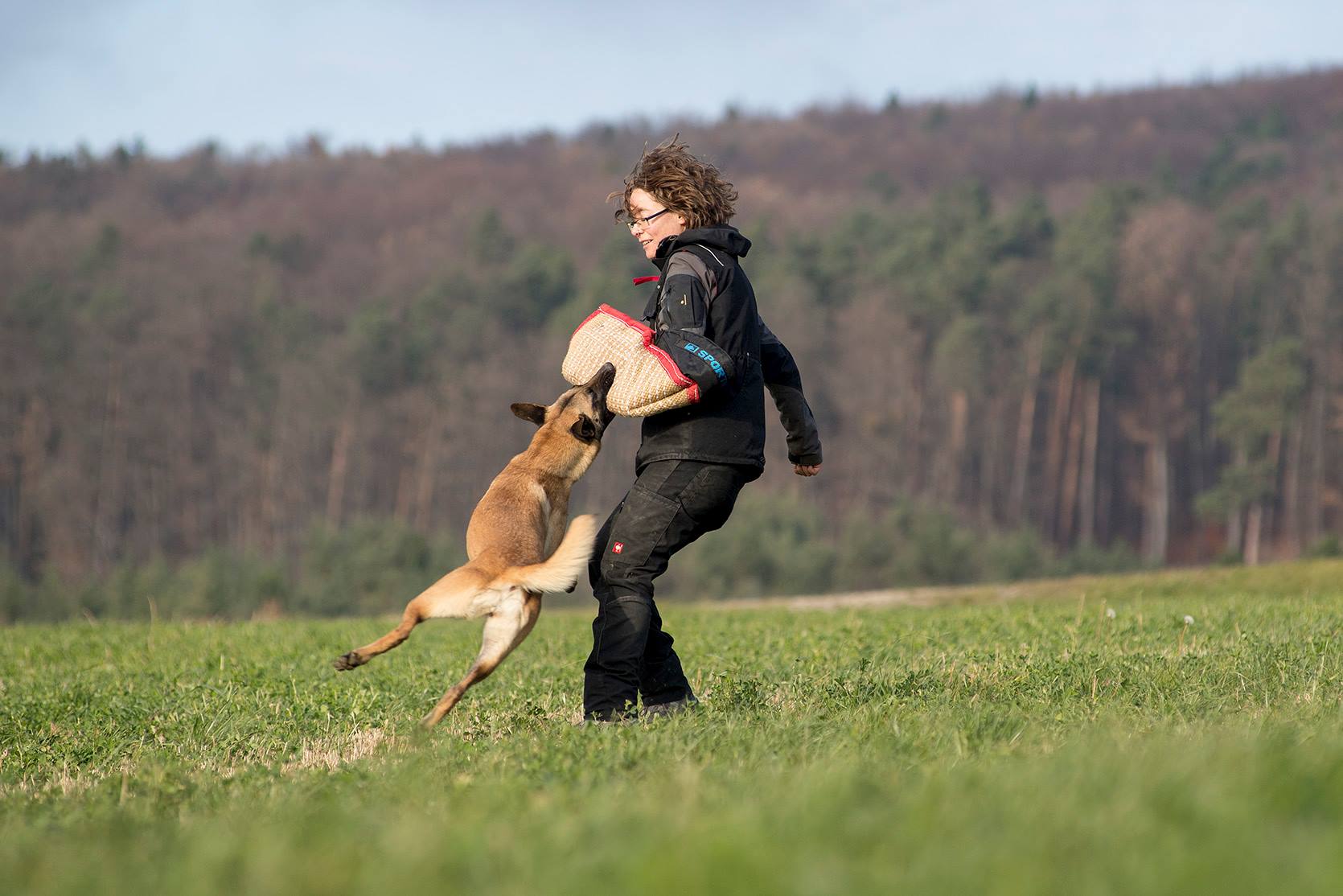
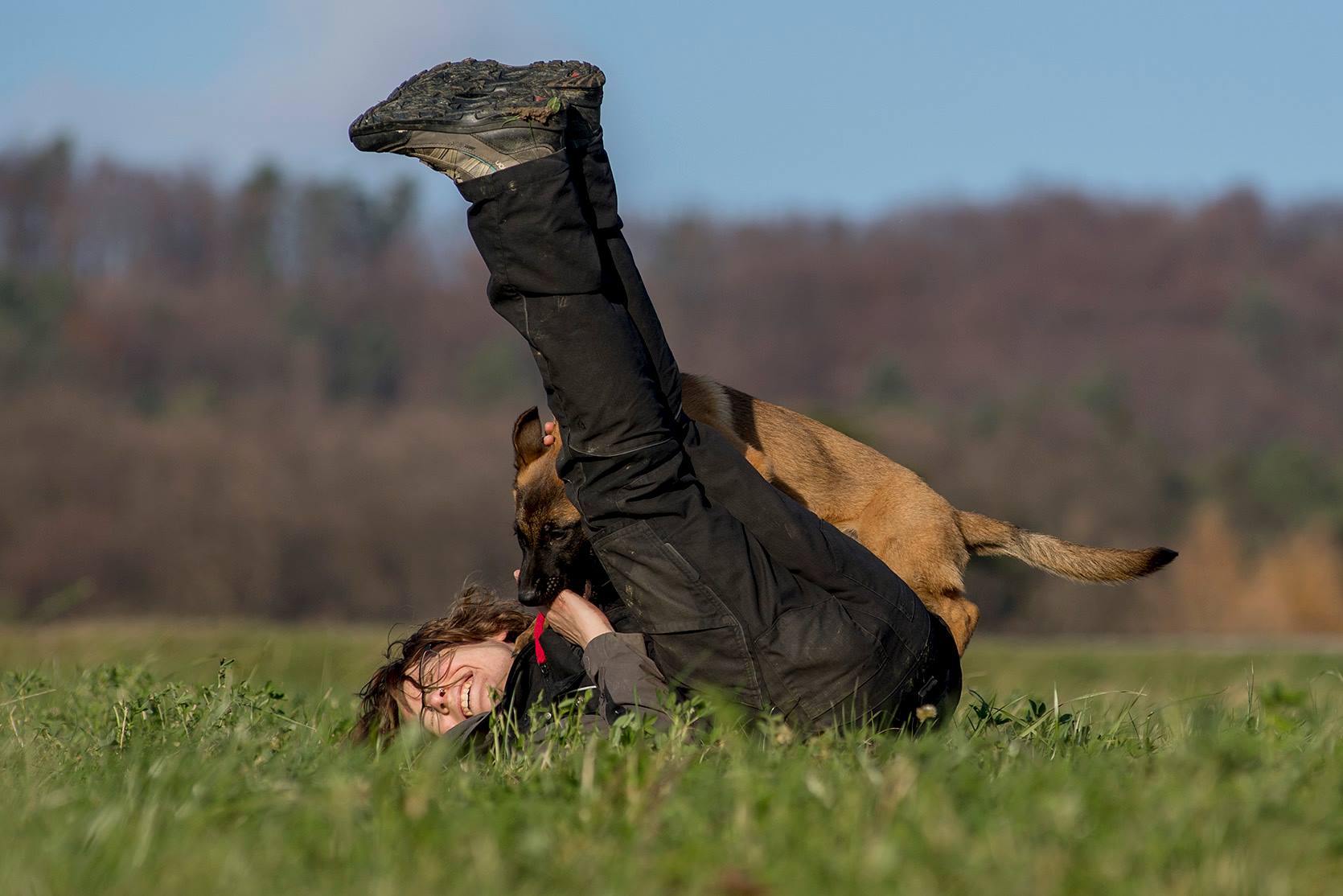
One of my favorite ways of completing my own stress cycles is playful exercise as well: it’s roughhousing with my dogs. Watching 20-something canine kilos barrell towards you, bracing for the impact, and catching them on a bite sleeve is exhilarating. It requires coordination and concentration. It makes me feel strong. I trust, and I am being trusted. Play-fighting within the rules of the game we established is my perfect stress release: I am completely immersed in this activity. I exist in the current moment in a way I rarely do otherwise. I am moving my body and engaging my muscles in a controlled manner. And I am playing with my dog. Give me a 5-10 minutes of this, and life will be better – at least for the next couple hours. The good thing is that I can go right back for another round if needed!

Roughhousing and rolling on the floor with puppy Game (picture by Isabelle Grubert).

The good news, and the bad news

The bad news: life is stressful. Empty out your bucket, and it’s starting to fill again right away: navigating maskless crowds in supermarkets in a COVID world, being late, the Internet is down, and you’re out of coffee … It’s the little things as well as the big ones, and they just keep coming. All of these are stressors. They are conspiring to turn on the faucets that will continue spitting stress-related neurochemicals into our buckets (the stre-ss).

But there’s good news, too: once we know how to, we can empty out our buckets anytime – even when the stress-ors are still ongoing. I can pick up a bite sleeve and play with my dog until I’m out of breath, and have forgotten everything about the things that aren’t going my way. I’ll feel better, and will be able to not worry about it – until the chemicals in my stress bucket reach a certain level again, and it’s time to empty out the bucket again.

Be your dog’s advocate

Unlike us, our dog’s can’t always choose when to empty their buckets. More often than not, the activities they get to engage in are up to us rather than up to them.

Being aware of Game’s stress response is important because it helps me support her: I can set her up for success. For example, the other day, I met a friend in the crowded center, and we were going to walk up a hill. This is the kind of activity I’d usually bring Game on. Not last week: I knew that the stress of being around strangers would outweigh the benefits of moving her body on a leashed walk. I’ve also told a number of people who wanted to be introduced to her “No” over the last couple of days. Game is a dog who generally enjoys meeting new people – but not when she’s already running low on energy. She can’t speak for herself, so it’s up to me to be her advocate.

How about *your* dog?

What clusters of behavior does distress track for your dog? How do you support them when external stressors lower their threshold, and how do you help them complete the stress cycle? Also: how about yourself?

Below: an excerpt of Game’s stress-release fun, and one of our favorite road trip songs: “Lift your / head up …”

PS: Today, as I hit “publish” on this post, it’s more than 5 weeks post surgery. Game is doing great – especially since she’s finally allowed to play tug, and fetch hard balls again!


Resources mentioned in this post

Nagoski, Amelia & Emily – Burnout

Travel thoughts E1: dog/dog sociability

I had fun with The Brindle Girl series, and decided to do more video-style posts. I’m hoping this will tie me over until I go back to speaking in front of groups of people. I was going to record these while driving across Guatemala and Mexico – but it turned out that the AC blasting and the car were too much background noise. So I’m only recording these post road trip. They are still travel thoughts, so I’m keeping the name!

The first video post below is my musings about dog/dog sociability. After recording this, I remembered that I recently learned something that contradicts my anecdotal experience: dog breeds, it turns out, are much less predictive of an individual’s behavior and personality traits than we conventionally think they are.

How do we know that? As of today (May 27, 2021), the Darwin’s Ark project has analyzed 3,056,323 answers provided by the owners of 29,233 dogs. At the 2021 Lemonade Conference, Elinor Karlsson explained their approach in a captivating talk that was amazingly understandable even for someone like me, with zero training in data analysis or statistics. If you get a chance to catch one of her presentations – make sure you don’t miss it!

Based on what Elinor Karlsson and colleagues have found, you should take my video musings with a grain of salt! So before you watch my video – here’s the scientific caveat:

In relation to predicting sociability, we’ve learned two things from Darwin’s Ark:

  1. An individual dog’s behavior and personality traits can not accurately be predicted if all we know is their breed.
  2. Dog breeds have some subtle differences in behavior and personality when compared to all (pet) dogs.
    However, these differences are not clear for all factors examined in the Darwin’s Ark project. For example, there are no statistically significant breed differences when it comes to factors like agonistic threshold, and dog sociability – two factors relevant to my musings below.

The Cheesecake Challenge, or an Experiment in Resisting Negative Reinforcement

One thing that training dogs has taught me is to better understand certain behavioral patterns in myself. Here’s an example.

I dislike unsolicited advice. I try to refrain from giving it to others, and it annoys me when it is bestowed on me by friends who (I feel) should know better.

And yet, a lot of the time, my response to unsolicited advice is to reinforce the unsolicited advisor by thanking them for their help. As a result, the friend is likely to give me more unsolicited advice in the future. The spiral of miscommunication continues.

Why on earth would I thank them for something I didn’t want? I recognized what I was doing, and I was puzzled by it – until I observed a completely unrelated behavioral pattern in dogs.

Learning to tug

Some dogs show little natural interest in playing with a tug toy. A common method of teaching them to tug is to excitedly tease and slap them with the toy and push the toy into the dog. Lots of dogs learn to tug this way.

Throughout the training process, a handler who uses this method is getting positively reinforced for teasing and slapping the dog with the toy: the dog grabbing and pulling on the toy is equivalent to me saying thank you to an unsolicited advisor. It’s a powerful positive reinforcer for the handler or the unwelcome advisor, respectively.

But what is happening from the perspective of the dog? Pause for a second before you continue reading past this paragraph. Is the dog’s tugging behavior strengthened and maintained by …

(A) positive reinforcement,
(B) positive punishment,
(C) negative reinforcement,
or (D) negative punishment?

Scroll down to see if you were right!

tugging, dog training, dog trainer, play

The answer is (C): negative reinforcement. The dog in our example doesn’t naturally care about tug toys. The trainer slapping and teasing him with the toy, trying to put it in his mouth, slapping some more while talking excitedly is irritating, confusing, intimidating or annoying to the dog. In an effort to escape the trainer’s behavior, he will sooner or later try grabbing the toy.

That very instant, the slapping, teasing and pushing stops. Wow! A moment of relief! The dog just learned that he can stop his owner’s craziness by grabbing and holding on to the toy. The better he understands his ability to influence the handler’s behavior, the sooner will he grab the toy. Eventually, he’ll start tugging as soon as the toy is presented. Voilà – the dog has learned to tug via a negative reinforcement procedure.

I assume many dogs eventually start to enjoy tugging as such, even if they initially learned by means of negative reinforcement. Some dogs, however, may never truly enjoy to play tug, and keep doing it mostly in order to not get slapped and teased with the toy.

Me? I’m like the latter kind of dog when it comes to thanking people for their unsolicited advice. I keep doing it to escape the pressure of being expected to respond.

Unsolicited advice

Being showered with unsolicited advice from friends – whether it is dog training advice, dating advice, or life advice – feels like being slapped with a tug toy. It’s irritating. It makes me feel yucky and disrespected. If that were the only force at play here, I’d probably actively reject the advice (applying positive punishment), or ignore it (applying extinction).

The pressure to respond and the crux of kindness

However, two other strong forces come into play as well:

  • My need to respond to my friends’ messages (the equivalent of “will to please” in a dog),
  • and the belief that kindness is more important than honesty, i.e. we should not do things that may hurt our friends’ feelings (the equivalent to living by a certain rule structure we sometimes observe in herding breeds).

When a friend writes me a message, the ball is in my court, and I feel like I NEED to give the ball back to them. As long as the ball is in my court, it’s as if the slapping and teasing with the tug toy continued. Having a friend’s ball in my court is pressure – that’s why I’m having a really hard time just ignoring unsolicited advice.

So I will eventually respond – and I’ll be nice about it. I feel like I need to respond to my friend’s good intentions rather than to the effect their unsolicited advice-giving behavior has on me.

I’ll probably at least say “Thank you” or a send a smiley face or a thumbs up emoticon. While this is the weakest reinforcer available to me, it is still strong enough to maintain my friends’ unsolicited advice-giving.

The Challenge

Now that I’m aware of what has been maintaining my grateful responses to unsolicited advice, I’m going to conduct an experiment: I’ll try to change my own reaction, and find out if I can reduce unsolicited advice giving that way. At the very least, I expect to feel better when learning to respond in a way that is in line with my feelings about unsolicited advice. (The training parallel here would be giving the dog a way to opt out of playing tug.)

I’m going to start with focusing on advice given in written form, online. My alternative response to unsolicited advice will be to close the chat window instead of replying. I’m going to use a food reward for myself: I will treat myself to the world’s best cheesecake, which is sold at a local café, contingent on closing the chat window. I’ve only had this cheesecake twice because it’s fancy and expensive cheesecake, but I think about it every time I walk past the café. Starting today, for the next four weeks, I’ll have cheese cake every time I close a chat window on an unsolicited advisor. I’ll see how it goes!

How about you? Has dog training changed your understanding of your own behavioral patterns or the behavioral patterns of the humans around you? Would you like to design your own version of the cheesecake challenge? Share your thoughts in the comments!

Chrissi travels internationally learning about dogs, and makes money to support her roaming by teaching online at FDSA, in person in Guatemala, and seminars around the world. Contact Chrissi for more information.

What happens in your body when you run into a lion?

I’ve been translating parts of my German-language book on fearful puppies, and decided to rewrite and extend my introduction to the specific training protocols for helping young dogs conquer their fears. All my protocols stress patience and working under threshold. Here’s the reason why:

Psychogenic distress has a number of physiological effects we should be aware of when trying to help a puppy overcome her fears. There are two systems that get activated under stress: the sympatho-adreno-medullary (SAM) axis, and the hypothalamic-pituitary-adrenal (HPA) axis. Let’s look at them by means of an example.

Imagine you are walking to the supermarket. Suddenly, a lion jumps out of a driveway. The SAM axis responds immediately – your adrenaline levels rise quickly, and you are getting ready to outrun or fight the lion! A few minutes later, your adrenaline levels drop back to normal again. The same holds true anytime your puppy meets “her lion” – no matter whether that’s indeed a lion, a person on crutches, a strange dog or a teenager on a skateboard.

The HPA axis, on the other hand, is activated more slowly and remains active longer. It leads to the release of cortisol. Indeed, your cortisol levels will only peak approximately 20 minutes after you ran into the lion, and elevated cortisol levels can be measured in your body for up to an hour or two after the stressful event. Again, the same things happen in your puppy’s body when she encounters a trigger.

Why is this relevant when trying to change your puppy’s negative associations to skateboarders, men in hats, or strange dogs? Staying under threshold in training is significantly more effective than training in a state of mind our dog would be in if she saw a lion: anytime your puppy experiences distress, her ability to learn is compromised. While we do want to face the triggers your puppy is concerned with, we need to stay at a point where they do not trigger the physiological responses associated with distress. A puppy’s brain is most receptive when she is in a relaxed and attentive state of mind. That’s why, in order to maximize the training benefits for your sensitive puppy, you should stick to the recommended maximum duration of the training protocols as well as the minimum relaxation times in between sessions. If your puppy “goes over threshold” (i.e. the physiological stress response is triggered), you don’t only lose the benefits of your current desensitization session, but also of the following reps: the physiological stress response takes a while to subside, and only when your puppy’s body has returned to homeostasis can you effectively change her association to a trigger by one of the protocols described below.

Stress Stacking

Earlier in this chapter, we learned that adrenaline and cortisol levels don’t immediately drop back to normal the moment a real or metaphorical lion disappears: adrenaline levels stay elevated for several minutes, and cortisol levels for up to two hours. When several minor stressors happen immediately one after the other, the total level of stress keeps rising. That is to say the puppy doesn’t process them one after the other (image 1), but simultaneously (image 2).

stress stacking counterconditioning dog training
Image 1: Meeting several minor stressors in a row isn’t all rainbows and unicorns

An isolated trigger that is only perceived as slightly stressful by your puppy might cause your puppy to run away, freezy, alarm-bark or air-snap if it happens simultaneously or soon after another minor or major stressor. Stress stacking is also the reason many moderately reactive puppies and dogs don’t react to the first or second trigger they meet on a walk, but will react to the third one.

stress stacking counterconditioning dog training
Image 2: … but more like meeting a lion!

Thresholds and Relapses

And there is another reason I recommend always working at a distance to the trigger that is great enough to avoid fear reactions. Experiments show a connection between elevated heart rate during training sessions and future relapses. This hasn’t only been studied on animals, but also on people undergoing exposure therapy in order to conquer phobias. The results showed that the subject was most likely to relapse when the level of fear they themselves reported to be experiencing was out of line with the level of fear indicated by their heart rate. This is why I don’t like using food lures when socializing fearful puppies: a food-motivated puppy may be tricked into approaching someone she wouldn’t approach otherwise, only to realize she is in way over her head once she has swallowed the food.

Special thanks to FDSA instructor Jessica Hekman for making making sure I got the science right! Jessica also pointed me to one of her articles, which wasn’t only helpful, but also interesting and enjoyable to read. Check it out if you want to learn more about psychogenic stress in hospitalized dogs!

Chrissi travels internationally learning about dogs, and makes money to support her roaming by teaching online at FDSA, in person in Guatemala, and seminars around the world. Contact Chrissi for more information.